Saturday, 28 February 2009

Get your traps on.


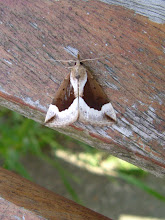
Had the mv light trap on for the first time in Northowram last night and caught this Common Quaker(above).At sugar I had 7 Satellites and 1 Chestnut.

Thursday, 26 February 2009

Tuesday Night


Hi all, On tuesday night A very nice Oak beauty came to the Skinner trap. Winston

Psychoides verhuella


Hi all
I just bagged this species (new lifer for me) here on the Llyn Peninsular this week and its probably around now in Calderdale as well.You need to look on Hartstongue fern (Phyllitis scolopendrium ) on the sporangia under the leaves. It makes distinctive cases from the old sporangia and its possible to see the larva feeding head first in the mine it makes. You need to look on the older leaves that have gone brown. Its just a case of truning over leaves until you spot it. If you find it the larva has a black head and anal plate. If the head plate is light brown its a related species called 200 Psychoides filicivora

I seem to remember that there is a large area of this fern on the path up from the main road to Underbank near Jumble Hole clough. Its the track Sue and I took you on last year Andy. It will be a good record as I never really looked for it in Calderdale, so new record awaits someone.

Mystery Micro


Hi all, is this little moth a rather rolled up Tortricodes alternella?


Winston

Monday, 23 February 2009

False Dawn

After last weeks excitement the last three nights have produced zero moths! However there is a March moth near the trap tonight, photos to follow hopefully.

Actually not such a false dawn after all, 1 Chestnut, 1 Pale brindled beauty and 1 more March moth arrived!

Winston

Grass Tip for Charly


391 Cocksfoot Moth Glyphipterix simpliciella


I searched the old last years flowering stems of cock's foot (Dactylis glomerata), up the lane from the caravan today and found several showing the chracteristic holes in the stem (see photo) which is made by the larva before it pupates to facilitate its emergence as an adult later in the year. I find the holes are usually between 4 and 12 inches from the top of the stem. If you are not sure of the grass; its the big clumps you see with large dead stems emerging from the center, see top photo. I found this species in Calderdale but usually in a sheltered spot, not if the plant was in an exposed situation. If you want to rear them through; just stick some occupied stalks (they should all be pupa by now) into some florists dry oasis and pop them into a plastic jar (Dobsons sweet shop in Elland will give you as many as you want) and pop some old tights or pop sock over the top and the adults should emerge around May/June.

Ivy Tip


1002 Lozotaenia forsterana
I found a couple of occupied leaves on Ivy (Hedera) this morning here in N.Wales containing larva of this species. Its a species I have looked for in the past in Yorkshire in its larval stage but never found until today here in Wales. Lots of the older leaves on the plants I searched had old feeding signs so I assume the larva moves from leaf to leaf whilst feeding. The only occupied leaves I found were on the newer green growth. I also found some spun together leaves which I think have E.postvittana larva in them. Much more detail of L.forsterana can be seen on Ian Kimbers UK Moths website at http://ukmoths.org.uk/show.php?id=489 Lots of detailed images by Ben Smart appear showing the full larval stages and the adult.
PHOTO Curtesy of Ben Smart

Saturday, 21 February 2009

Is it too early?

to start running the Actinic trap?

Thursday, 19 February 2009

Spring ushers in !


My First Ever Spring ushers arrived last night. One dark specimen and one light together with 3 Pale Brindled beauties.

Ivy Blisters

found these blisters on ivy plants in Hebden, are these leaf mines and if so can the miner be identified? or are they a caused by something else?
Winston


Wednesday, 18 February 2009

Bradford Botany Group

For those of you of a botanical nature, I’ve attached the summer programme of the Bradford Botany Group. They are a great bunch and although very learned they are very friendly. They are visiting a couple of places in Calderdale this year (Crow Nest quarry, Hipperholme (with Halifax Scientific Society) and Clifton Lagoons) and some close by. It’s a good way to see visit interesting reserves and see rare and unusual plants with a nice bunch of people. So do come along if you can. No previous experience required.... great if you are a beginner like me!eddie Jolly(BAP co-ordinator)
CROW NEST QUARRY, HALIFAX Sun, 14th June2:00 pm
Joint visit with the Halifax Scientific Society. The in-filled quarry has a variety of soil types and a diverse flora including good numbers of bee orchid. We aim to produce a complete species list for the site, since it is under threat from development.Leaders: Edie Jolley and Andrew Kafel
SE 132 248From Hipperholme crossroads (SE 124 255), take the A644 SE towards Brighouse. After 1.5 km, turn left just after the Dusty Miller pub, then left again into Spout House Lane. After 400m, the road bends left and turns into St Giles Lane. Take the small lane on the right leading to the football ground car park Wed,
QUEENSBURY TRIANGLE ,15th July 6:45 pm Partly landscaped former railway station and goods yard. Several local and interesting species including wood vetch, northern dock and possibly dittander. Easy walking.Leader: Jesse Tregale SE 107 309 Take the A647 out of Bradford towards Queensbury. About 100 metres before the main crossroads turn right into Station Road at SE104 303. This is a tarmac road, but very rough in places. Park at the end (approx. 500m) by the roadside at the above GR. Wed, 29th July6:45 pm

CLIFTON LAGOONThis area forms part of the Calder flood plain and incorporates a small lake. Plants of interest include pepper-saxifrage, rough hawkbit and, reputedly, lesser bulrush. There are many planted trees on the periphery of the site.Leader: Andrew Kafel
SE 167 221 From M62 junction 25 (Clifton, M62/A644), take the A644 east towards Mirfield and, after just 200 metres, park in the lay-by on either side of the road. The entrance to the site is on the south side of the road.

Sunday, 15 February 2009

Guyanan interlude


Hi all, A friend of mine has gone to live on the edge of a rainforest in Guyana for a few years! He lived in Hebden and Calderdale for some time and has sent back this pic taken last week just to make us jealous of the tropical conditions out there. I believe it is a Female Monarch. Roll on summer, Winston

Thursday, 12 February 2009

Excellent Book


I can highly recomend this book on British and Irish Butterflies,packed full of information on where to see all the British species of butterfly.

Sunday, 8 February 2009

Lepidoptera Apprentice /job anyone.?

BTCV Natural Talent Lepidoptera Apprentice
Organisation: BTCV Scotland
Salary: £12,568
Location: Edinburgh and RSPB Insh Marshes
Position Type: Paid/Fixed Term Contract
Part/Full Time: Full Time
Closing Date: 09 Feb 09
Website: www.btcv.org/naturaltalent
Contact: Tricia Burden
Contact Telephone: 01786 479697
Contact Email: Scotland@btcv.org.uk


Details:
The Lepidoptera apprenticeship will cover the ecology, distribution and conservation of Moths. The apprentice will gain skills in identifying and recording Moths as well as techniques used for surveying and sampling. They will also learn preservation and curation techniques, working closely with Museums throughout Scotland on storage of historical material and voucher specimens.

As part of the apprenticeship, the apprentice will work alongside other Moth experts and with Conservation organisations such as RSPB and Butterfly Conservation to survey for and record LBAP and UKBAP species.
The apprentice will have the opportunity to work with other major collections of Lepidoptera in Scotland culminating in the writing of a report on an aspect of Lepidoptera conservation.

The Apprenticeship comes with a salary of £12,568 per annum, a training budget, equipment budget and travel budget. Anyone can apply for this post. You don’t need qualifications to apply, there are no age restrictions either; all we ask is that you have a passion for conserving our Natural Heritage and the drive, commitment and determination to complete this apprenticeship to a very high standard.

Wednesday, 28 January 2009

RECORDS

Many thanks to everyone who has sent in records,I now have filed 24,000 records of moths in Calderdale from 1999 to present If anyone has any records past or present still to send in please do.Cheers and lets hope for a warm and long spring/summer and autumn.

Tuesday, 27 January 2009

1st Caterpillar 2009

Found an Elephant Hawkmoth caterpillar while digging out pathways at Beechwood Park. It could be a good site to try some moth trapping on later in the year.

First Arrival of 2009


After a few no shows with the Skinner trap so far in 2009, This fine Pale Brindled Beauty (melanic form) arrived overnight. The game's afoot. Winston

Friday, 23 January 2009

Hints and Tips

Hi all
As some of you know I run the UK micros yahoo forum and I used to post a regular feature called Moth of the Moment (MOM) every week or so giving hints and tips on topical species people may wish to look for. Most of the tips are sent into me by others and I simply pass them on as and when its a topical species. Last year with my house move etc I dropped this as I simply did not have the time. I am now starting this up again on UK Micros so if you want a few hints and tips, mainly on larvea hunting and mainly micros look on the UK micromoths forum or if Andy wishes I could cut and paste them here as well ?

Sunday, 18 January 2009

Larvae hunting

Brian Leesey found 7 Anomalous and 6 Autumnal Rustic larvae at langfield edge last night before the bad weather forced him off the moor.

Thursday, 15 January 2009

YNU Lepidoptera Group Meeting

Sunday 8th March 2009
YNU Lepidoptera Group Meeting
Bramham Village Hall
Grid Ref: SE427430
Event Contact: Terry Crawford
10:30 for 11:00 meeting will close by 16:00
The annual meeting of the YNU Lepidoptera Group,If any body fancys going please leave a commont below

Wednesday, 14 January 2009

No Show

Hi all, Had the trap out last night and night before but nothing I'm afraid for 2009 as yet
Winston

Friday, 9 January 2009

Brown House Moth...Hofmannophila pseudospretella


This was flying round the kitchen today.

Thursday, 8 January 2009

Leaf Mines

Hi all
Rob Edmunds has just let me know that himself, Willelm Nellis and with help from Brian Pitkin are about to write an Aidgap key to leafmines. Some prelims will be sent out to field test before the final draft. Anyone interested in taking part in this ?

We have a thaw underway here in Edern after 15 days or so frozen solid. I might try out the MV in the garden tonight if the thaw continues.

Wednesday, 7 January 2009

New Book


The new book on Moths and Butterflies by Manley is superb. You not only get all the macro moths and butterflies photographed, you also get a load of micros and caterpillars. I only wish the book had been around when I first started.

Tuesday, 6 January 2009

Why not in Yorkshire ?

Hi all
Just thought I would send you this link which helps moffers here in North wales. It would be nice if you guys eventually got something similar for Yorkshire. Look out for my few records appearing later this year I hope.

http://www.trawsgoed.com/

Monday, 5 January 2009

First Moth today


1 Mompha subbistrigella found resting on a dead oak tree in the local wood .It was very small indeed and difficult to photo.

Saturday, 3 January 2009

Caterpillar ID

Hi Chris
As Derek suggested the larva is likely to be Brimstone moth. I was not 100% sure as I have never seen this species in the larval form before. I sent your image to Reg Fry and he comfirms it is indeed likely to be Brimstone. Try to rear through if you can and then Andy will have confirmed breeding at CB. I have always assumed it did breed at CB but its nice to have confirmation.

Blwyddyn Newydd Dda from Sue and Paul

Thursday, 1 January 2009

Happy New year


Minus 5 and Snow in Northowram last night,,,,,no Moths ...but a Happy New Year to you all.

Thursday, 25 December 2008

Merry Xmas

A very happy and enjoyable Christmas and happy and healthy 2009 to all from Paul & Sue in North Wales.

Monday, 22 December 2008

Winter Moths

Had a Winter Moth by the outside light last night and also 1 Chestnut &1 Satellite at sugar and 1 Light Brown apple moth this evening.Just like to say thanks to everyone who has posted on this site over the year and I hope you all have a good holiday and a great new year(lets hope its a warm spring and hot summer):)
Brian leesey recorded,2 Satellites,1 Red Green Carpet and 1 Ypsolopha ustella,

Friday, 19 December 2008

Caterpilla for id.?


Chris found this caterpillar down at Cromwell Bottom earlier today, any idea what it might be.

Cheers
Chris

Wednesday, 17 December 2008

December Moth

Anyone recorded this in Calderdale yet ? I never recorded it in Calderdale despite living and looking in what appeared to be the perfect habitat, yet here in Edern I see it regularly at light around the caravan despite the habitat seeming to be less likely to hold a population.

I assume from the lack of posts in recent times Calderdale is in its usual South Pennines " grey grot" time of year weather wise and nothing much is around ? We still get the odd Hoverfly and Bumblebee around on sunny days and moths are around most mild nights but we are also hoping for a good start to the new year with some more settled warmer weather and a much improved summer in 2009.

Free Book

Hi all
I hav just found a copy of The Flora of the Parish of Halifax by Frank Murgatroyd of the Halifax Sci Soc. This list the locations of many plant species in Calderdale so is useful for finding food plants. First come first served can have the copy free of charge, I just need a postal address.

Thursday, 4 December 2008

BBc i- player

http://www.bbc. co.uk/iplayer/ episode/b00fy3yk /Natures_ Top_40_Episode_ 2/

Brookfoot Moths


Cresent

Green Silver lines

Beautiful China Mark
A few from Brighouse this year,Thanks to Mike and Kath

Wednesday, 3 December 2008

Quiz


Any one like to take a guess at this one.Taken at light Brookfoot Brighouse 3rd July 2008.

Monday, 1 December 2008

RE.Dart species 13 August 2008(NCD)

Hi all,I've just completed my first Gen Det on the Dart species found by Nick Dawtry on the 8th August this year.Its not easy with five thumbs on each hand and two small pins,caustic soda and a micro wave to get used to.But with a good deal of patience I have identified it as a Whie -line Dart Euxoa tritici.an excellent find

Saturday, 29 November 2008

Moth for ID


Just going through some old photos and came across this moth. I found it down at Cromwell Bottom on 17th June 2007. Can anyone help me ID it?

Friday, 28 November 2008

Angle Shades


My son shouted ...Dad theres a moth on the wall...... I was suprised to see one of these.......the garden was well frozen this morning. ... as it turns out my latest by 2 weeks.

Tuesday, 25 November 2008

Caterpilla for id.?


Any one got any ideas on this found today on the outside wall,Speckled Wood/Yellow Shell.?

Friday, 21 November 2008

Silence of the Lambs moth find a mystery

South Yorkshire daily Star November 1st 2008
By Staff Copy,via Yorkshire Moths and my Dad
AN EXOTIC visitor from far, far away is providing a perplexing puzzle for staff at Sheffield's Botanical Gardens.
Gardeners have found a rare Death's Head Hawk Moth – a giant of its kind famous for featuring in the blockbuster chiller The Silence Of The Lambs.
The seven centimetre moth – which can boast a wingspan of up to 13 cms when fully grown and is the largest species ever seen in the UK – was found dead in the glass pavilions.
It was taken to moth enthusiast Ed Kelly, who owns the Gatehouse Gift Shop at the gardens, for identification.
Ed called in Sheffield University etymology expert Richard Naylor, who was equally baffled by the exotic immigrant.
The sinister-looking creature's natural habitat is in southern Europe, and how one ended up in Sheffield is a mystery.

Ed said: "To see a moth like this is an incredibly rare event.

"Richard said they are sometimes blown here across the Channel but only a few arrive each year and they never breed here."

Specimens making it into the UK are sometimes found in southern England, but hardly ever make it north.

Ed added: "Richard wondered if it had been transported here in one of our plants or in the soil, but we've had no recent deliveries like that.

"It looks like it has just emerged from its chrysalis but has died perhaps because it is too cold.

"It is a bit gruesome – it has the distinctive skull marking on its back."

The moth will be on display in Ed's shop for the next few days and will then be donated to the university.

Wednesday, 19 November 2008

Sugaring Caution

Hi all
Not meant to be scaremongering but please be very, very careful should you decide to boil up your own sugaring mix. As you have to dissolve sugar and the mix turns into the equivalent of runny jam its very very hot when boiling (like jam it boils at a higher temp than water)and it tends to boil over if not watched and it tends to spit and splash out of the pan. If it lands on bare skin in the hot state it sticks like napalm and burns just as badly. Its got a wonderful appetising scent like sweet toffee and is irresistible to kids and pets so must never be left unattended until its cool for obvious reasons.

Second point and this request has been made many times in other forums. Please do not spread the mixture on trees with mosses and lichens on the bark as it kills the moss and lichen and thus spoils the biodiversity of the tree and spoils it for other people who prefer mosses and lichens to moths as a hobby.

Hints on Sugaring

This is taken from the excellent 'Practical Hints for the field Lepidopterist'by J.W. Tutt,a good x-mas present to yourself and can be got from Pennine Books(link on the right of screen) run by P.Talbot.Also the new edition of Skinner is out soon.
Sugaring should be attempted side by side with sallowing. It sometimes happens that when sallows are unattractive moths may be taken at sugar, and vice versa. We are indebted to Alderson for some excellent notes on "sugaring" (Ent. Rec., i., p. 140). He states that he always uses coarse brown sugar, when procurable, but has found old black treacle quite as effective. Blackberries, gathered when ripe, and boiled down with sugar, form an excellent substitute, and is especially attractive to the Xanthiids. When laying the sugar on, it is advisable to add a little rum (methylated spirit, jargonelle, and other substitutes are also used by various collectors), every dozen trees or so, rather than to mix the whole previous to starting. It is also desirable to commence in sufficient time to allow finishing the last tree on the round before dusk, the first hour being as a rule the most productive. A long thin line (the width of the brush) almost to the foot of the tree is better than a small patch, one advantage of the former method being that the insects are not clustered so closely, and fewer escape, especially if one commences by throwing the light first at the bottom of the tree. On a windy night the majority of the moths are frequently on the lowest part of the sugar, the upper portion being almost deserted, whilst those Noctuids that fly nearest the ground are much more likely to be attracted. It is also always worth while to sugar a quantity of small-limbed trees, as these frequently pay well when the bare trunks of large trees are little patronised. It is advisable, too, to shake the brush over low-growing shrubs, and also to carefully let a drop of sugar fall on the centre of thistle and other composite flowers, or to sprinkle a little over the flower-heads of Eupatoriur. Be careful also to keep at work on the same ground, the moths appear to congregate more on a round that is continually worked, and the trees kept constantly sugared. Changing ground does not usually prove particularly productive, especially for the first few nights, besides, the fact that more sugar is required on a new round is important, an old round wanting very little to freshen it up. Boxes should always be ready when renewing old sugar, as many species, early on the wing, will be found already at the bait, and, the spirit having evaporated from the latter, these early-comers are usually exceedingly wary.

RECORDS PLEASE

Hi all,If any one has there records ready for this year(2008) could they please send them to me at my e-mail adress Thanks to those who have allready sent them in .Andy

Tuesday, 18 November 2008

Red sword Grass

2 Red Sword Grass recorded at sugar last night in Todmorden from a new site also 8satellites,Chestnut and yellow line Quaker,from a new recorder called Marolyn.

BBC i player

http://www.bbc. co.uk/iplayer/ episode/b00fj265 /Inside_Out_ South_West_ 121
A small bit on a moth trapping session on i-player,if this link does'nt work you will av t cut and paste

Monday, 17 November 2008

News from todmorden over the weekend

1 Feathered Thorn
9 Red Green carpet
1 Juniper Carpet
10 Chestnut
14 Satellites
3 Brick
1 angle Shades
2 Yellow Lined Quaker
6 Light Brown apple Moth
Again Brian proves there still out there in good numbers.!
I had 1 Chestnut and 2 Light Brown apple moth up here but I think Wenesday looks ok this week.

Wednesday, 12 November 2008

Only House wood/Northowram

Just about manage to sugar a few trees this evening before it got too dark ,-
1 Red Green carpet
3 Chestnut
1 Satellite(orange spots)

Saturday, 8 November 2008

Last nights moths

Another productive night at Mv light in Todmorden with Brians first Scarce Umber of the year,he also recorded Winter moth ,Mottled umber,Common Marbled carpet,Red Sword grass in Northowram I recorded 30 moths of 8 species with my first 'white spotted' Satellite,despite the wind it was a good night.

Thursday, 6 November 2008

Red Sword Grass?

Apologies for the poor photo but is this a Red Sword Grass? found in Midgley tonight

Wednesday, 5 November 2008

News from todmorden

Brian recorded the following at his Mv125 last night in Todmorden
13 Red Green carpet
1 autumn Green Carpet
1 red sword Grass
1 feathered thorn
1 blairs Shoulder Knot
1 yellow line Quaker
1 Light Brown apple Moth
and 2 Torts to id

Tuesday, 4 November 2008

Last Night's 3 visitors

1 Common Marbled Carpet
1 Rather worn (poss yellow) Quaker
and this male Mottled Umber which shows no sign of a central spot on the forewing

Mondays moffing


Not a bad day for November all in all,started with a daytime Winter Moth flying around the local wood.Then had 8 Chestnut,1 agonoptrix arnella,1 Satellite(orange spots) and this Feathered Thorn at sugar and Angle Shades and Acleris sparsarana at the outside light.

Thursday, 30 October 2008

Horse Chestnut Leaf - Miner


Derek Parkinson recorded 366a Horse Chestnut Leaf-miner Cameraria ohridella at Norwood Green over the weekend,this is the first record of this species in Calderdale.Many thanks to Derek for this information.This pasage below and Photo are taken from the excellent UKmoths site ......-

This species was discovered near Macedonia in 1985, and since then has spread rapidly to other countries in Europe. It was first discovered in Britain at Wimbledon in south-west London in 2002, but possibly had arrived the previous year, as it was quite plentiful. It is thought that the species may be expanding partially due to accidental transportation by man, either by road or rail. It has now been found quite extensively in the south-east of England.
The larva mines the leaves of horse chestnut (Aesculus hippocastanum) causing noticeable brown blotches, often many to one leaf. There is however, a similar-looking fungus which can cause confusion.
The adult moths resemble other Gracillariidae, although are quite distinctively dark reddish-brown with a noticeable white frons. It is thought that three generations exist.
Many thanks to UKmoths and Derek for this info.

Sunday, 26 October 2008

Sugaring at Gorpley Clough(sunday eve)

Rain,high winds and clearing skies didn't make us feel very optimistic as we sugared the trees at Gorpley Clough ,but as the light faded we were soon recording moths..
15 Chestnut
11 Brick
4 Satellite
2 Winter Moths
2 Yellow Line Quaker
1 Angle Shades
1 Red Sword Grass
A real cracking evening and well worth the effort,good to see Brian and photo's to follow from Charlie

Baffled Butterflies


'click on text above to read'
Another interesting article from the latest BCYB by H.Frost, Argus no 55 showing another reason for population crashes in Butterfly populations.It was a poor year for most species in Calderdale except the Browns with the best ever year for Ringlet and good numbers of Meadow Brown,Speckled wood and the ever increasing Gatekeeper.This was mirrored in the rest of Yorkshire.I think I only saw 4 Painted Ladys in the whole year.?Many thanks for all the new photos in the gallery its looking quite a good reference source now.

Friday, 24 October 2008

Parasitica

Following on from Charlie's superb series of photos of the parasites on the LBAM larva I thought I would make a plea for others to post any images they record and keep both the remains of the larva and an adult of whatever parasite emerges. I have the contact address of Dr Mark Shaw at Edinburgh University who is one of the foremost experts on parasitica in the UK. Mark is always grateful for any specimens with data that you can collect for him. He will often be able to name the parasite and let you know details about it. He also uses the specimens sent as voucher material in the university collection, so you will be contributing to our long term knowledge of the parasitica collected. I obviously do not want to post Marks details on the web, but you can contact me via the blog or email for the details

As an example of how useful specimens from Calderdale can be; I used to pot up any adult parasitica I found in my moth trap and pop em in the freezer to store them. Once a month I would put all the parasitica collected into a specimen pot of a alcohol and send them off to Mark. He used all the specimens he could ID as voucher specimens in the uni collection for others to study. The specimens from Calderdale were even more useful in the fact that they came from a more northerly aspect of the UK than most specimens in the collection which in the main came from the SE of England. Several differences where noted between the Calderdale and the other specimens in terms of size and other minor details that had not been noted before in descriptions. In fact one species (whose name escapes me at the moment) was in fact THREE time larger than any other specimen of this species that Mark had seen and he had no idea thay could grow to this size. Several of the specimens I sent had not been recorded from Yorkshire before, so they also contributed to the known distribution. For those who might interested in knowing more about the parasitica Mark has written a small inexpensive book for the AES about them.

When rearing larvae I find that quite a high proportion of then have been got at by some parasite or other and in many cases you have no idea until the parasites emerge from the larva or pupa. I had an ichneumon emerge from an Elephant Hawkmoth pupa once spring which frightened the hell out of me when I opened the pot expecting to see an adult Elephant Hawk only to be confronted by a bloody enormous black and white and very angry inchneumon from which I fled at a rapid rate ! I also used to get lots of a particularly nasty Tachinid fly from Northern Egger larva. The egger larvae used to feed up as normal but them just as they were moving around the tubs seemingly getting ready to pupate they would suddenly stop moving and out would wiggle dozens of small white maggots eating their way out of the by now hopefully dead larva. In about 20 mins the larva went from a seemingly happy healthy Egger to a empty bag of skin.I have some photos somewhere of these maggots munching their way out and will see if I can find them and post them on the blog

January Moths

There are a few about in January Charlie and when running the MV light at Park Road, I rarely blanked even on the worst nights. I was unusual in being just about in Park Wood with my back garden and most winter flying moths occur in woodland. My one tip would be to make sure you get the light on or get out looking before dusk as the first hour of dusk can be the only time all night that moths move if the sky is clearing and temperatures dropping. The list below is the the species list for my MV trap in January from 2000 to 2004. Spring Usher earliest date 3rd January, lastest date 26th February

Light Brown Apple Moth (Epiphyas postvittana)

Acleris ferrugana/notana

Tortricodes alternella

Ypsolopha ustella

Winter Moth (Operophtera brumata)

Pale Brindled Beauty (Phigalia pilosaria)

Mottled Umber (Erannis defoliaria)

Scarce Umber (Agriopis aurantiaria)

Satellite (Eupsilia transversa)

Chestnnut(Conistra vaccinii)

Northern Winter Moth (Operophtera fagata)

Dotted Border (Agriopis marginaria)

Thursday, 23 October 2008

Sunday Evening

Hi all,I am meeting with Brian Leesey at Gorpley Clough to run the trap and sugar some trees on Sunday evening.It should be dark by 5ish(clocks go back sat night).Staying for a few hours until the temp drops off.All welcome if any one wants a lift please leave a message below.

Tuesday, 21 October 2008

Wellholme Park

A walk around Wellholme Park this afternoon produced 1 Red Darter. I know it's not a butterfly, but I thought a few people might be interested.

Chris

Still hanging in there


One Comma today in the afternoon sunshine at Northowram

Migration and Global warming


If you click on this picture you should be able to read this very interesting article.Closer to home the number of Butterfly species in Calderdale is definitely on the increase and new moth species are also on the increase ie Light Brown Apple Moth,Blairs Shoulder Knot,Black rustic etc.But the numbers of common moths are on the decline through habitat loss and farming practises.This is why all the information/data we collect is locally very important .If any one has records for Calderdale(old or new) please could you send them to me and please include date,how many,how you saw it ie daytime obsevation,light trap or sugaring etc.Many thanks Andy

Friday, 17 October 2008

2009 National Moth Night

I see that Butterfly Conservation have given the date for National Moth Nights 2009. They will be on Friday 18 and Saturday 19 September 2009.

Do you think that it might be possible to arrange a few trapping sessions across Calderdale to see what we get.

They have no specific species or habitats that they are targetting, however the theme is migration. Andy mentioned earlier that we might like to get the LNR lists of moths and butterflies up to date. (I'm still collating the various info on the different sites, but for many it is pretty sketchy), so one option is to do some trapping on one of these sites.

We may also (as the Council) run a public moth trapping event on one of these nights and publicise it in the Wildside guided walks and events programme, if anyone would be interested in helping out, especially with the identification then please let me know.

Thursday, 16 October 2008

Today's sightings

1 Red Admiral butterfly this afternoon in Cunnery Wood LNR.

Tuesday, 14 October 2008

Last nights moths


Wine Ropes at Hallwood Todmorden :-
42 Chestnut
1 Saterlite
1 yellow line Quaker
6 brick
Sugaring Only House Wood Northowram :-
20 Chestnut
5 Brick
1 Green Brindled Cresent
MV Northowram :-
1 Ypsolopha sequella (Rabbits ears and all)
1 Silver Y
10 Light Brown Apple Moth
2 Garden Rose Tortrix
1Common marbled Carpet

Monday, 13 October 2008

Photo Gallery

Hi all,many thanks to everyone who uploaded photos over the weekend .There are now nearly 200 species listed and we should be able to get up to 300 in the near future.And maybe 400+ by this time next year.If you click on view and then thumbnails it gies you a better view of the photos.many thanks Andy

Last nights moths

MV 125 Skinner trap in back garden
18 Light Brown apple Moth
3 Garden Rose Tortix
5 Red Green Carpet
1 Silver Y
2 Blairs Shoulder Knot
1 Autumn Green carpet
2 Spruce Carpet
3 Common Marbled Carpet
1 Barred Sallow
1 Angle Shades

Sugar in local wood
12 Chestnut
1 Angle Shades

Sunday, 12 October 2008

Juniper Pug ?

I had this Pug on Friday night and think it may be a melanistic Juniper Pug - British & Irish Pug Moths state that Juniper Pug occurs until late September so it is just a little late, any ideas?

Few other Moths so far this month include Angel Shades, Silver Y, November Moth spp, Red-green Carpet, Brick and Yellow-line Quaker, very quite,

Brick

Yellow-line Quaker


November Moth spp - either November or Pale November Moth

Silver Y

Todmorden wine Ropes

Brian Leesey reports 47 Chestnut,Red Sword grass and 2 Tawny Pinion last night at wine ropes in Hallwood .

Friday, 10 October 2008

Gallery open to post

The gallery is now open for anyone to post there photos on it ,Martyn your open on both your e-mails,just click on the green add files and away you go.The B+F numbers can be found on UKmoths in the links area.If not I will add them later.

Thursday, 9 October 2008

Today's sightings


Alegar Bank Wood - Brighouse

1 Large White
1 Paletussock caterpillar (pictured)

For Charlie !


Hi Charlie

As the most active field lepidopterist in Calderdale I have set a little challange for you. I found twice only the cases of 563 Coleophora argentula on Yarrow (Achillea millefolium ) in Calderdale. I found this at Cromwell Bottom and Lowfields Business Park (before they built on it) and at that time thought I had bagged a new Yorkshire record (its slowly moving north) but Harry Beaumont beat me to it by a year :-(( I am not sure if it occurs on the garden forms of Yarrow as I never found it on any I searched, but there again I only ever found it on two clumps of Yarrow in the wild. It must occur I am sure in other parts of Calderdale but as Yarrow is not exactly abundant it might take some searching for. I have found it today here on the Llyn but as Yarrow is very abundant I was not surprised at finding it. The cases can be found right through winter but I suspect many go to ground later this month to astivate.


The reason I ask for you to look for it is that sadly BOTH patches of the plant were destroyed, built on at lowfields and buried by the countryside unit at Cromwell Bottom :-((
PHOTO: Courtesy of Ben Smart

LARVAE ON RAGWORT SEPTEMBER/OCTOBER

Below is a wholes series of tips to find moths on Ragwort. This was given out by Ian Smith some years back on Uk Micromoths. Most of the links will no longer work but all can be found on Ian Kimbers UK Moths website, just type in the B&F number given in the link to Ians search engine. PS Charly, I expect some cracking shots of all the goodies you find to stick in my Ragwort File !


In response to your request for more tips I decided to expand on what you may find on ragwort this month. Most of the larvae feed on the flowers/seeds. Some are foliage feeders, but you are likely to get either when you beat.The exceptions are the rootstock/lower stem feeders. For these you will need to uproot plants, and, if occupied, pot them up outside over winter.I don't think anyone will object to the removal of ragwort plants, but could I suggest that lifted plants are not left where stock can reach them. I think farm animals have the sense to avoid living plants, but wilted plants might not have the same warning signs. Accidental inclusion in hay is probably the main danger. Virtually all the micros listed overwinter as diapausing larvae, so essential to keep outdoors in well drained conditions. Many of the macros overwinter as pupae, but outdoors also best. 998postvittana will probably pupate & emerge indoors in airtight container to prevent drying.Below are links to micros that feed on ragwort in September. Where the link is to images in my file 'ifs' on ukmicromoths, you should copy them if you wish (just for own use -I retain copyright) as I will eventually remove them in late October. I have included polyphages I have found on ragwort, but there may be more.964 rootstock/stemhttp://groups.yahoo.com/group/ukmicromoths/files/ifs/rag964.jpg966rootstock/lower stemhttp://ukmoths.org.uk/show.php?id=2936985http://ukmoths.org.uk/show.php?id=3559http://groups.yahoo.com/group/ukmicromoths/files/ifs/rag985.jpg986http://groups.yahoo.com/group/ukmicromoths/files/ifs/rag986.jpg998http://ukmoths.org.uk/show.php?id=19151187rootstockhttp://groups.yahoo.com/group/ukmicromoths/files/ifs/rag1187.jpg1197http://groups.yahoo.com/group/ukmicromoths/files/ifs/rag1197.jpghttp://groups.yahoo.com/group/ukmicromoths/files/ifs/rag1197b.jpg1377http://groups.yahoo.com/group/ukmicromoths/files/ifs/rag1377.jpg1480http://groups.yahoo.com/group/ukmicromoths/files/ifs/rag1480.jpg1484http://ukmoths.org.uk/show.php?id=24621485http://groups.yahoo.com/group/ukmicromoths/files/ifs/rag1485.jpg1520http://ukmoths.org.uk/show.php?id=32741521H. osteodactylus(1520) is apparently replaced in SE England (Kent, Sussex, Surrey according to Eric Bradford, but perhaps Colin Hart can update us?) by H. chrysocomae(1521). I have no picture. Colin told me that as far as he knows its head is light brown, while on osteodactylus it is black or dark brown. As head colour of larvae often lightens or darkens with development, I'd be cautious about relying on it alone.I hope anyone who gets Hellinsia larvae in the SE will photograph and rear it (outdoors) - I'll be delighted to receive and photograph larvae sent to me from Kent, Sussex or Surrey. It's also reported off Solidago virgaurea and Aster (?Sea aster?).952 I have no illustration of 952Commophila aenana. Rootstock feeder. Winters about 8cm up stem which snaps off above the larva by spring. Heavy clay soils from Lincoln southwards. Scarce. BTS describes: Head brown;prothoracic plate pale yellow; abdomen yellowish or greyish white; pinacula shining greyish white; spiracles blackish brown peritreme; anal plate greyish white marked yellow.Below are Bradley numbers of macromoths which you may beat off ragwort. All are in Porter, but beware of variability of the pugs; some spp have 20 or so varieties illustrated in Buckler, with certain forms resembling those of other species.I think many need to be reared.17201728http://ukmoths.org.uk/show.php?id=27801825http://ukmoths.org.uk/show.php?id=25321830, 1833, 1834, 1837, 1839, 18401851http://ukmoths.org.uk/show.php?id=2573I think Eupethicia virgaureata can be recognised by the stylised wave patterns on its sides.2136,2305http://ukmoths.org.uk/show.php?id=1474

Mythical Moths rediscovered

Just got my latest copy of Butterfly from BC and two moths have been rediscoverd after decades of absense.One in Scotland Ethmia pyrausta only recorded 4 times since 1853 and White Prominent in Ireland the first for 70 years both found at light on organised moth nights.Brindled Ochre is surley still out there in Calderdale.?

Wednesday, 8 October 2008

King of the Skies

Hi All
I have seen a great many large dragonflies this late Summer / Autumn, a lot more than usual. Took this pick of Aeshna cyanea (m) imm ( I think thats what it is, at least) near Yatton late September. Can anyone confirm id?

Winston

Tuesday, 7 October 2008

Photo Gallery

Hi all,the photo gallery has now just short of 100 species in it,If any one has any photo's of species not on the gallery please could they add to or send me there photo's.I propose to have the gallery closed on mondays(or any day) to add photo's if this is ok with everybody.? I will send an invite to anybody who has photos to add.

Historical Note on Brindled Ocre

Just been reading JW Tutt...Pratical hints for the field Lepidopterist(written in the early 1900's) and came across this in the October section..In The Halifax and Huddersfield areas Brindled Ocre is freely taken at gaslamps in the early morning and by 'dint of hard work ;on average a ton of stones(dry stone walls been favoured)must be moved to find one specimen......any one fancy a bit of dry stone walling????
There are no recent records of this species that I can find.

Sunday, 5 October 2008

ogden

this morning
1 speckled wood
1 emperor dragonfly
1 peokcock

Thursday, 2 October 2008

October Butterfly

One pristine Red Admiral today in a garden in Brighouse anyone else had an October butterfly

New Yahoo Moths

Hi all
I am currently setting up a new group on Yahoo to cover hints & tips on finding lepidoptera. The idea is to have have 12 monthly files that tips can be added to for each family of lepidoptera in the UK. I have couple of people who are helping out with hints and tips but the forum is not public yet until I get some more stuff loaded up. The group will be available for public viewing but you will have to be a member to post. This is a long term project I have been interested in for years and hopefully it will grow into a large resource giving people an idea when and how to find lepidoptera. Hopefully you guys who like to get out in the field looking for lepidoptera will wish to contribute.