Thursday, 9 October 2008

For Charlie !


Hi Charlie

As the most active field lepidopterist in Calderdale I have set a little challange for you. I found twice only the cases of 563 Coleophora argentula on Yarrow (Achillea millefolium ) in Calderdale. I found this at Cromwell Bottom and Lowfields Business Park (before they built on it) and at that time thought I had bagged a new Yorkshire record (its slowly moving north) but Harry Beaumont beat me to it by a year :-(( I am not sure if it occurs on the garden forms of Yarrow as I never found it on any I searched, but there again I only ever found it on two clumps of Yarrow in the wild. It must occur I am sure in other parts of Calderdale but as Yarrow is not exactly abundant it might take some searching for. I have found it today here on the Llyn but as Yarrow is very abundant I was not surprised at finding it. The cases can be found right through winter but I suspect many go to ground later this month to astivate.


The reason I ask for you to look for it is that sadly BOTH patches of the plant were destroyed, built on at lowfields and buried by the countryside unit at Cromwell Bottom :-((
PHOTO: Courtesy of Ben Smart

LARVAE ON RAGWORT SEPTEMBER/OCTOBER

Below is a wholes series of tips to find moths on Ragwort. This was given out by Ian Smith some years back on Uk Micromoths. Most of the links will no longer work but all can be found on Ian Kimbers UK Moths website, just type in the B&F number given in the link to Ians search engine. PS Charly, I expect some cracking shots of all the goodies you find to stick in my Ragwort File !


In response to your request for more tips I decided to expand on what you may find on ragwort this month. Most of the larvae feed on the flowers/seeds. Some are foliage feeders, but you are likely to get either when you beat.The exceptions are the rootstock/lower stem feeders. For these you will need to uproot plants, and, if occupied, pot them up outside over winter.I don't think anyone will object to the removal of ragwort plants, but could I suggest that lifted plants are not left where stock can reach them. I think farm animals have the sense to avoid living plants, but wilted plants might not have the same warning signs. Accidental inclusion in hay is probably the main danger. Virtually all the micros listed overwinter as diapausing larvae, so essential to keep outdoors in well drained conditions. Many of the macros overwinter as pupae, but outdoors also best. 998postvittana will probably pupate & emerge indoors in airtight container to prevent drying.Below are links to micros that feed on ragwort in September. Where the link is to images in my file 'ifs' on ukmicromoths, you should copy them if you wish (just for own use -I retain copyright) as I will eventually remove them in late October. I have included polyphages I have found on ragwort, but there may be more.964 rootstock/stemhttp://groups.yahoo.com/group/ukmicromoths/files/ifs/rag964.jpg966rootstock/lower stemhttp://ukmoths.org.uk/show.php?id=2936985http://ukmoths.org.uk/show.php?id=3559http://groups.yahoo.com/group/ukmicromoths/files/ifs/rag985.jpg986http://groups.yahoo.com/group/ukmicromoths/files/ifs/rag986.jpg998http://ukmoths.org.uk/show.php?id=19151187rootstockhttp://groups.yahoo.com/group/ukmicromoths/files/ifs/rag1187.jpg1197http://groups.yahoo.com/group/ukmicromoths/files/ifs/rag1197.jpghttp://groups.yahoo.com/group/ukmicromoths/files/ifs/rag1197b.jpg1377http://groups.yahoo.com/group/ukmicromoths/files/ifs/rag1377.jpg1480http://groups.yahoo.com/group/ukmicromoths/files/ifs/rag1480.jpg1484http://ukmoths.org.uk/show.php?id=24621485http://groups.yahoo.com/group/ukmicromoths/files/ifs/rag1485.jpg1520http://ukmoths.org.uk/show.php?id=32741521H. osteodactylus(1520) is apparently replaced in SE England (Kent, Sussex, Surrey according to Eric Bradford, but perhaps Colin Hart can update us?) by H. chrysocomae(1521). I have no picture. Colin told me that as far as he knows its head is light brown, while on osteodactylus it is black or dark brown. As head colour of larvae often lightens or darkens with development, I'd be cautious about relying on it alone.I hope anyone who gets Hellinsia larvae in the SE will photograph and rear it (outdoors) - I'll be delighted to receive and photograph larvae sent to me from Kent, Sussex or Surrey. It's also reported off Solidago virgaurea and Aster (?Sea aster?).952 I have no illustration of 952Commophila aenana. Rootstock feeder. Winters about 8cm up stem which snaps off above the larva by spring. Heavy clay soils from Lincoln southwards. Scarce. BTS describes: Head brown;prothoracic plate pale yellow; abdomen yellowish or greyish white; pinacula shining greyish white; spiracles blackish brown peritreme; anal plate greyish white marked yellow.Below are Bradley numbers of macromoths which you may beat off ragwort. All are in Porter, but beware of variability of the pugs; some spp have 20 or so varieties illustrated in Buckler, with certain forms resembling those of other species.I think many need to be reared.17201728http://ukmoths.org.uk/show.php?id=27801825http://ukmoths.org.uk/show.php?id=25321830, 1833, 1834, 1837, 1839, 18401851http://ukmoths.org.uk/show.php?id=2573I think Eupethicia virgaureata can be recognised by the stylised wave patterns on its sides.2136,2305http://ukmoths.org.uk/show.php?id=1474

Mythical Moths rediscovered

Just got my latest copy of Butterfly from BC and two moths have been rediscoverd after decades of absense.One in Scotland Ethmia pyrausta only recorded 4 times since 1853 and White Prominent in Ireland the first for 70 years both found at light on organised moth nights.Brindled Ochre is surley still out there in Calderdale.?

Wednesday, 8 October 2008

King of the Skies

Hi All
I have seen a great many large dragonflies this late Summer / Autumn, a lot more than usual. Took this pick of Aeshna cyanea (m) imm ( I think thats what it is, at least) near Yatton late September. Can anyone confirm id?

Winston

Tuesday, 7 October 2008

Photo Gallery

Hi all,the photo gallery has now just short of 100 species in it,If any one has any photo's of species not on the gallery please could they add to or send me there photo's.I propose to have the gallery closed on mondays(or any day) to add photo's if this is ok with everybody.? I will send an invite to anybody who has photos to add.

Historical Note on Brindled Ocre

Just been reading JW Tutt...Pratical hints for the field Lepidopterist(written in the early 1900's) and came across this in the October section..In The Halifax and Huddersfield areas Brindled Ocre is freely taken at gaslamps in the early morning and by 'dint of hard work ;on average a ton of stones(dry stone walls been favoured)must be moved to find one specimen......any one fancy a bit of dry stone walling????
There are no recent records of this species that I can find.

Sunday, 5 October 2008

ogden

this morning
1 speckled wood
1 emperor dragonfly
1 peokcock

Thursday, 2 October 2008

October Butterfly

One pristine Red Admiral today in a garden in Brighouse anyone else had an October butterfly

New Yahoo Moths

Hi all
I am currently setting up a new group on Yahoo to cover hints & tips on finding lepidoptera. The idea is to have have 12 monthly files that tips can be added to for each family of lepidoptera in the UK. I have couple of people who are helping out with hints and tips but the forum is not public yet until I get some more stuff loaded up. The group will be available for public viewing but you will have to be a member to post. This is a long term project I have been interested in for years and hopefully it will grow into a large resource giving people an idea when and how to find lepidoptera. Hopefully you guys who like to get out in the field looking for lepidoptera will wish to contribute.

Tuesday, 30 September 2008

September Moths

All recorded in back garden in September :-
Large Yellow Underwing 131
Common Marbled Carpet 86
Light Brown apple Moth 74
Garden Garden Tortrix 42
Lesser Yellow Underwing 38
Garden Carpet 36
Rosy Rustic 24
Silver Y 16
Angle Shades 15
Blairs Shoulder knot 15
Black Rustic 15
Acleris lat/com 11
Lunar Underwing 9
Spruce Carpet 5
Red Green carpet 5
Feathered ranunculus 4
Frosted orange 4
Willow beauty 3
Vapourer 3
Straw Dot 3
Acleris sparserana 3
Flounced rustic 2
Square spot Rustic 2
Small Square Spot 2
White Sh House moth 2
Mouse Moth 2
Barred Sallow 2
Nettle tap 2
Autumn Green Carpet 2
Dark arches 1
Small phoneix 1
Mottled beauty 1
Autumunal rustic 1
Sectaceaus Hebrew character 1
Pink Barred sallow 1
Burnished Brass 1
November moth 1

Monday, 29 September 2008

Photo Gallery

I have set up a photo gallery which was discussed earlier.On the right hand side press Photo Gallery this should open a public gallery and you should see a few old pics from this site,I intend to add all the great photo's that have been on the blogg so far and a few from field trips etc.Thanks to NigelK for his help

Sunday, 28 September 2008

Lunar Underwing?

Found in the Actinic yesterday morning, is this a Lunar Underwing?

Saturday, 27 September 2008

Ringstone Saturday

2 red admiral
1 Common darter
1 Brown Hawker
1 Vapourer
1 Peacock
Brian Leesey reports a Black Darter at Langfield Common yesterday

Friday, 26 September 2008

Midgely Moffer


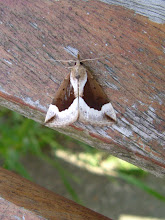
Nick Carter reports a very quiet week at Midgley with this Brown spot Pinion and Autumunal Rustic the highlights.

Tuesday, 23 September 2008

Last nights moths


Feathered Ranunculus and Frosted Orange from last night

Monday, 22 September 2008

Topical Tip

I spotted that large areas of Ivy are now in flower here in Edern as I walked down the track to the coast for a spot of fishing this afternoon (a nice Pollack now filleted and awaiting cooking for my tea). The ivy flowers were covered in butterflies, silver y moths, hoverflies and bees, all feeding away on the flowers. Searching Ivy by both day and night is supposed to be as good as "sallowing" in spring. To be at its best you need a decent sized patch and it not to be too tall as its hard to spot moths much above head height. I know of one excellent patch in Calderdale (I'm sure there must be hundreds more), its on the wall between the canal and river just past Red Beck on the canal. Park at Avocet and walk down to just past the bend near the Red Beck and there is a superb patch of Ivy which flowers profusely each year is never above head height, perfect for some night shots or netting and is always covered in insects as long as the weather is fine (its been a scorcher here again this afternoon)

AES Bulletins & Bug Club Mags

I have a few copies of the Amateur Entomological Society Bulletin going free to a good home, all this years issues so far. I also have some copies of the Bug Club magazine, these are aimed at younger members of the AES but are still a good read for adults or kids. Anyone want any or all of these let me know and I will pop them in the post free of charge.

Sunday, 21 September 2008

Charming little critter.


My first post here. Would love to know what this is. Andy C posted this up earlier.
I found it today near Queensbury.
I'm a birdwatcher with an increasing interest in wildlife generally and very out of my depth when it comes to moths, butterflies and wriggly plant eaters to name a few. Would really appreciate your id input please. Probably nothing rare but it's attractive and it's exciting finding all sorts of critters locally.

Weekends moths

Frosted orange 1
Barred Sallow 1
Pink Barred Sallow 1
Lunar Underwing 2
Black Rustic 4
Feathered Ranunculus 1
Willow Beauty 1
Rosy Rustic 3
Garden Carpet 2
Common Marbled Carpet 6
Large YU 10
Lesser YU 1
Angle Shades 1
Light Brown Apple moth 12
Garden Rose Tortrix 9
Small Sq Spot 1
Acleris sp 4