Tuesday, 4 November 2008
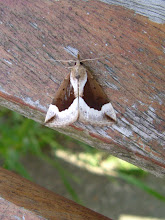
Last Night's 3 visitors
Mondays moffing
Thursday, 30 October 2008
Horse Chestnut Leaf - Miner

Derek Parkinson recorded 366a Horse Chestnut Leaf-miner Cameraria ohridella at Norwood Green over the weekend,this is the first record of this species in Calderdale.Many thanks to Derek for this information.This pasage below and Photo are taken from the excellent UKmoths site ......-
This species was discovered near Macedonia in 1985, and since then has spread rapidly to other countries in Europe. It was first discovered in Britain at Wimbledon in south-west London in 2002, but possibly had arrived the previous year, as it was quite plentiful. It is thought that the species may be expanding partially due to accidental transportation by man, either by road or rail. It has now been found quite extensively in the south-east of England.
The larva mines the leaves of horse chestnut (Aesculus hippocastanum) causing noticeable brown blotches, often many to one leaf. There is however, a similar-looking fungus which can cause confusion.
The adult moths resemble other Gracillariidae, although are quite distinctively dark reddish-brown with a noticeable white frons. It is thought that three generations exist.
Many thanks to UKmoths and Derek for this info.
Sunday, 26 October 2008
Sugaring at Gorpley Clough(sunday eve)
15 Chestnut
11 Brick
4 Satellite
2 Winter Moths
2 Yellow Line Quaker
1 Angle Shades
1 Red Sword Grass
A real cracking evening and well worth the effort,good to see Brian and photo's to follow from Charlie
Baffled Butterflies

'click on text above to read'
Another interesting article from the latest BCYB by H.Frost, Argus no 55 showing another reason for population crashes in Butterfly populations.It was a poor year for most species in Calderdale except the Browns with the best ever year for Ringlet and good numbers of Meadow Brown,Speckled wood and the ever increasing Gatekeeper.This was mirrored in the rest of Yorkshire.I think I only saw 4 Painted Ladys in the whole year.?Many thanks for all the new photos in the gallery its looking quite a good reference source now.
Friday, 24 October 2008
Parasitica
As an example of how useful specimens from Calderdale can be; I used to pot up any adult parasitica I found in my moth trap and pop em in the freezer to store them. Once a month I would put all the parasitica collected into a specimen pot of a alcohol and send them off to Mark. He used all the specimens he could ID as voucher specimens in the uni collection for others to study. The specimens from Calderdale were even more useful in the fact that they came from a more northerly aspect of the UK than most specimens in the collection which in the main came from the SE of England. Several differences where noted between the Calderdale and the other specimens in terms of size and other minor details that had not been noted before in descriptions. In fact one species (whose name escapes me at the moment) was in fact THREE time larger than any other specimen of this species that Mark had seen and he had no idea thay could grow to this size. Several of the specimens I sent had not been recorded from Yorkshire before, so they also contributed to the known distribution. For those who might interested in knowing more about the parasitica Mark has written a small inexpensive book for the AES about them.
When rearing larvae I find that quite a high proportion of then have been got at by some parasite or other and in many cases you have no idea until the parasites emerge from the larva or pupa. I had an ichneumon emerge from an Elephant Hawkmoth pupa once spring which frightened the hell out of me when I opened the pot expecting to see an adult Elephant Hawk only to be confronted by a bloody enormous black and white and very angry inchneumon from which I fled at a rapid rate ! I also used to get lots of a particularly nasty Tachinid fly from Northern Egger larva. The egger larvae used to feed up as normal but them just as they were moving around the tubs seemingly getting ready to pupate they would suddenly stop moving and out would wiggle dozens of small white maggots eating their way out of the by now hopefully dead larva. In about 20 mins the larva went from a seemingly happy healthy Egger to a empty bag of skin.I have some photos somewhere of these maggots munching their way out and will see if I can find them and post them on the blog
January Moths
There are a few about in January Charlie and when running the MV light at Park Road, I rarely blanked even on the worst nights. I was unusual in being just about in Park Wood with my back garden and most winter flying moths occur in woodland. My one tip would be to make sure you get the light on or get out looking before dusk as the first hour of dusk can be the only time all night that moths move if the sky is clearing and temperatures dropping. The list below is the the species list for my MV trap in January from 2000 to 2004. Spring Usher earliest date 3rd January, lastest date 26th February
Light Brown Apple Moth (Epiphyas postvittana)
Acleris ferrugana/notana
Tortricodes alternella
Ypsolopha ustella
Winter Moth (Operophtera brumata)
Pale Brindled Beauty (Phigalia pilosaria)
Mottled Umber (Erannis defoliaria)
Scarce Umber (Agriopis aurantiaria)
Satellite (Eupsilia transversa)
Chestnnut(Conistra vaccinii)
Northern Winter Moth (Operophtera fagata)
Dotted Border (Agriopis marginaria)
Thursday, 23 October 2008
Sunday Evening
Tuesday, 21 October 2008
Wellholme Park
Chris
Migration and Global warming

If you click on this picture you should be able to read this very interesting article.Closer to home the number of Butterfly species in Calderdale is definitely on the increase and new moth species are also on the increase ie Light Brown Apple Moth,Blairs Shoulder Knot,Black rustic etc.But the numbers of common moths are on the decline through habitat loss and farming practises.This is why all the information/data we collect is locally very important .If any one has records for Calderdale(old or new) please could you send them to me and please include date,how many,how you saw it ie daytime obsevation,light trap or sugaring etc.Many thanks Andy
Friday, 17 October 2008
2009 National Moth Night
Do you think that it might be possible to arrange a few trapping sessions across Calderdale to see what we get.
They have no specific species or habitats that they are targetting, however the theme is migration. Andy mentioned earlier that we might like to get the LNR lists of moths and butterflies up to date. (I'm still collating the various info on the different sites, but for many it is pretty sketchy), so one option is to do some trapping on one of these sites.
We may also (as the Council) run a public moth trapping event on one of these nights and publicise it in the Wildside guided walks and events programme, if anyone would be interested in helping out, especially with the identification then please let me know.
Thursday, 16 October 2008
Tuesday, 14 October 2008
Last nights moths

Wine Ropes at Hallwood Todmorden :-
42 Chestnut
1 Saterlite
1 yellow line Quaker
6 brick
Sugaring Only House Wood Northowram :-
20 Chestnut
5 Brick
1 Green Brindled Cresent
MV Northowram :-
1 Ypsolopha sequella (Rabbits ears and all)
1 Silver Y
10 Light Brown Apple Moth
2 Garden Rose Tortrix
1Common marbled Carpet
Monday, 13 October 2008
Photo Gallery
Last nights moths
18 Light Brown apple Moth
3 Garden Rose Tortix
5 Red Green Carpet
1 Silver Y
2 Blairs Shoulder Knot
1 Autumn Green carpet
2 Spruce Carpet
3 Common Marbled Carpet
1 Barred Sallow
1 Angle Shades
Sugar in local wood
12 Chestnut
1 Angle Shades
Sunday, 12 October 2008
Juniper Pug ?
Few other Moths so far this month include Angel Shades, Silver Y, November Moth spp, Red-green Carpet, Brick and Yellow-line Quaker, very quite,
November Moth spp - either November or Pale November Moth