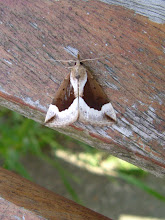
Hi all,
do we have a date for going trapping in Knott Wood next week?
I am free all days appart from tuesday.
I also now finally have a net!
Win
Friday, 9 April 2010


Wednesday, 7 April 2010
Last Night in Hebden Bridge
All these came to a rather soggy skinner trap during the night
Common Quaker 16
Hebrew Character 1
Clouded Drab 1
Agonopterix heracliana/ciliella 1
Diurnea fagella 2
Chestnut 6
Small Quaker 1
total 29
Common Quaker 16
Hebrew Character 1
Clouded Drab 1
Agonopterix heracliana/ciliella 1
Diurnea fagella 2
Chestnut 6
Small Quaker 1
total 29
Tuesday, 6 April 2010
Monday Night in Hebden


Hi all. A good night on the Rochdale Canal last night.
I am pretty sure this is A. acanthadactyla (A new species for me) as it's a more red-brown colour and less speckled than its close relative A. punctidactyla which also seems to have a more southern distribution. (Charlie, what do you think as I recal you having this one once). I have also included pictures of possibly the lightest Clouded Drab I have seen and a very nicely marked Twin-spotted Quaker.
Amblyptilia acanthadactyla 1
Twin-spotted Quaker 1
Twin-spotted Quaker 1
Diurnea fagella 1
Chestnut 9
Clouded Drab 2
Clouded Drab 2
Common Quaker 14
Total - 28 moths
Monday, 5 April 2010
Pheromones
http://www.angleps.com/pheromones.php
371 Lunar Hornet Moth Sesia bembeciformis (Hübner, 1806) 1
Collinson wrote .’This species is well established in the trunks of mature sallows throughout the district 1965’.No recent records.
381 Large Red-belted Clearwing Synanthedon culiciformis (Linnaeus, 1758) 1
Collinson wrote ‘Larve and empty pupa cases are easily found 1965’.No recent records.It may well be worth a look for these species in appropriate habitat .
Sunday, 4 April 2010
Knott Wood Sunday night
Clear skies and cool temps produced:-
Eriocrania semipurpurella x 1
diurnea fagella x 4
Acleris hyemena 1
Common Quaker x 36
Small quaker x 3
Clouded Drab x 3
Hebrew Character x 3
Brindled Pug x 1
Mottled Grey x 1
March Moth x 1
Red Chestnut x 1
Chestnut x 3
Eriocrania semipurpurella x 1
diurnea fagella x 4
Acleris hyemena 1
Common Quaker x 36
Small quaker x 3
Clouded Drab x 3
Hebrew Character x 3
Brindled Pug x 1
Mottled Grey x 1
March Moth x 1
Red Chestnut x 1
Chestnut x 3
Mottled Grey?

 The top photo is what we identified as a Mottled Grey a couple of days ago and the bottom is what we identified as a Mottled Grey from March of 2009, any comments? (click on photo for a larger image)
Mottled Grey and Early Tooth- striped
Saturday, 3 April 2010
Orange Underwing,03 04 10

Hi all,6 or so Orange Underwings,at Knott wood,but the 1st ive seen land,they are cracking moths ! regards Bri
Friday, 2 April 2010
Thursday, 1 April 2010
April Tips on Sallow
If you have a garage or outside shed, etc, now is the time to start collecting Sallow catkins which have fallen on to the ground from the Sallow trees. Many of these fallen catkins will often contain various Tortricidae, Geometridae and Pug larvae. The way to check the catkins for larvae is very easy. Simply spread them out on white kitchen roll in some seed trays or similar, no need for any sort of lid at this stage. If you keep checking the catkins you will see signs of frass appearing on the white kitchen roll under the occupied catkins. Once you find these move them to a lidded container and keep an eye on the situation. The larvae may need fresh catkins adding and then as soon as the sallow leaves are out pop some leaves in the tub with the occupied catkins. Some catkins will have only one species and some will have more than one species on/in them. Most of these are fine kept together until they are large enough to ID. The only exception to this are Pug larvae which I find are mostly cannibalistic even when enough food is present, if you want more than one survivor its pays to house pug larvae in solitary confinement ! Its great fun with catkins at this time of the year as you never know what you might find and rear through.
We are now getting close to the one of the best times of the year to find moths on natural food sources. Any night now when its cloudy and reasonably mild its the time to go "Sallowing". This is one of the great classic tecniques used before the advent of MV lights to collect large numbers of moths in one place. Cromwell Bottom is an ideal place to try this out but any area with large numbers of Sallow in bloom is fine. You simply stick a few pots in your pocket, pack a decent torch and a butterfly net. In practice one simply walks around shining the torch on Sallow catkins until you pick out a moth feeding, they can usually be spotted by the light reflecting off their eyes. One a good night there can be hundreds of moths on each Sallow bush, but often around here one is lucky to get a few dozen per bush. If its moth sp you wish to confirm or look through a hand lens its usually dead easy to simply pop the net over them and tap them off the catkins. They are mainly Orthosia spp, but also Chestnut, Satellite, perhaps some Thorns and Pugs. The only other time of year when one can get the same effect with natural sources is in autumn when you search Ivy Blossom in the same manner.
This was originally posted by Paul Talbot in April 2008
Knott Wood Sunday night
We are having a session on sunday night if anyone fancies it,,if we meet at Saville Bowling Club at the small car park bout 1945 ish, its 10 min walk,although it will be muddy in parts.Oak Beauty is target.
Wednesday, 31 March 2010
A Nice way to round off March

My eigth new species of the month came in the form of this Mottled Grey found resting on a dry stone wall at Norland village this morning. Its cold grey forewings matching the cold wet skies of this small pennine village.Charlie
sallowing

Dear All, shall we have another crack at sallowing. Can I cuggest we combine it with a lamp so at least we get something later on and shall we try somewhere else than Cromwell Bottom which has not been that successful. Any suggestions? Win
Sunday, 28 March 2010
Why did the caterpillar cross the road?


Sandra has just returned from a week in northen Spain (just south of Pyrenees) and took these videos of a line of caterpillars crossing a main road. The photos show the caterpillar and the cocoons she thinks they came from. We reckon they might be Small Eggar but really aren't sure.
Knott Wood sat night

Mottled Grey

Red Chestnut

Engrailed
Met with Bri,Winston and Martyn at Knott wood last night, in Northowram the wind was cold and the skies clear whilst at Hebden it was pleasantly mild with light wind.A good catch followed for the time of year.One Orange underwing was seen whilst setting up ---
Common Quaker 40+
Chestnut 8
Satellite 3(white spots)
Twin Spotted quaker 6
Yellow Horned 10
Mottled Grey 6
Hebrew Character 2
Clouded drab 7
Engrailed 3
Red Chestnut 6
Diurnea fagella 3
Although most were attracted to light all species were also found by searching tree trunks with a torch.
Saturday, 27 March 2010
Friday Night in Hebden
2 x Common Quaker
2 x Satelite (One white spots, on orange)
2 x Chestnut
win :-)
2 x Satelite (One white spots, on orange)
2 x Chestnut
win :-)
Friday, 26 March 2010
Knott Wood sat 27 03 10

We are having a session tomorrow night if anyone fancies it,sorry its short notice,if we meet at Saville Bowling Club at the small car park bout 1845 ish, its 10 min walk,although it will be muddy in parts.regards Bri.
Thursday, 25 March 2010
Spring Flowers

Hi All, sorry to go a bit off topic, at this time of year these little yellow flowers are everywhere near me. They always come after the snowdrops. what are they? Winston
Subscribe to:
Posts (Atom)