Wednesday, 16 April 2014

Copley meadow.

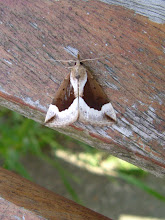
These Grapholita jungiella were pretty common this lunchtime flying in the warm spring sunshine. You wouldn't have thought that the grass blade was blowing quite violently in the breeze.

This one on oak in Bankhouse wood the day before.

Monday, 14 April 2014

New Camera

I thought it was about time for an upgrade so I bought a Panasonic Lumix FZ 200 with raynox lense. It can certainly produce some fine detail but the depth of field is minuscule even at F8. On the shot below the eye is nice and sharp but the nose is out of focus. If you consider these Eriocrania subpurpurellas are only 7mm in length I'll leave it up to you to work out the DoF.

It does take nice bird photos as well though!


Saturday, 5 April 2014

Brindled Ochre


2229 Brindled Ochre Dasypolia templi (Thunberg, 1792)

 This once common resident was found in 1883 around the new gass lamps and 100 + at gas lamps in Halifax in 1897.Was said to still occour up until the early 1960’s but no records since this date. Collinsonn wrote in 1963 the following article..-

The Yorkshire list states that nowadays this species is rarely recorded except on the East coast. Fortunately it does still occur in our Parish, though rarely. I have recorded three in recent years. It was once a feature of the Halifax Parish and collectors came from far afield to obtain it. There is a rather amusing story told in this respect. The Brindled Ochre emerges from the pupa in autumn. After some flight it seeks out a suitable place for hibernation until the Sallows are in bloom the following spring, at which time it reappears to carry on the species. A very suitable place for hibernation, and perhaps a reason why it so favoured our area, was between the stones of our drystone walls. A party of Lancastrian naturalists, apparently aware of this fact, crossed the border and were busily engaged taking down a wall in search of hibernating Brindled Ochres when the irate farmer appeared. He was unmoved by their pleas of scientific research and in due course they received fines from the local magistrate. The case caused quite a stir in more than naturalist circles and at least one national newspaper carried the headlines "The Case of the Butterfly Hunters." Unfortunately since those days the species has greatly declined. It is probable that this is one of the few species which we can definitely say has been reduced in numbers by the coming of modern street lighting.

Our old records read as follows:-

1883 Abundant round the new gas lamps. 1897 Over 100 at the gas lamps in Halifax.

These entries tell a sad story. It was interesting in 1946, whilst Sallowing (searching the flowering sallows for Spring specimens) with Stanley Sunderland, to have one of these moths actually settle on me. It proved to be a female and laid some eggs. The resulting larvae became the subject of one of a series of articles.
 The Brindled Ochre has not been recorded since 1963/4 in our area and has become very rare in VC63.We have looked for this species for the last 10 years and believed that there must be a small population still surviving in Calderdale and this record proves that...well chuffed...Martyn ,Andy and Bri


Friday, 4 April 2014

BOOM

663 Diurnea fagella 23
688 Agonopterix heracliana 4
701 Agonopterix ocellana 1
1760 Chloroclysta siterata Red-green Carpet 1
1775 Colostygia multistrigaria Mottled Grey 2
1852 Eupithecia abbreviata Brindled Pug 16
1881 Trichopteryx carpinata Early Tooth-striped 1
1930 Biston strataria Oak Beauty 3
2139 Cerastis rubricosa Red Chestnut 1
2182 Orthosia cruda Small Quaker 36
2187 Orthosia cerasi Common Quaker 85
2188 Orthosia incerta Clouded Drab 9
2189 Orthosia munda Twin-spotted Quaker 48
2190 Orthosia gothica Hebrew Character 3
2229Dasypolia templiBrindled Ochre1
2256 Eupsilia transversa Satellite 2
2258 Conistra vaccinii Chestnut 4

Thursday, 3 April 2014

Friday Craggs

Craggs usual spot Friday about 8ish...................

Tuesday, 1 April 2014

Small Tortoiseshell

After last years massive increase in numbers it was interesting  to see 14 today in the afternoon sunshine in the field opposite the  house ,  a long warm summer will surely re-establish this species to its former status. 2 Peacocks in the garden and 1 Diurnea flagella on the house wall. Planning a trapping session this Friday any ideas,?? Will post details later....

Sunday, 30 March 2014

March Round up ...Diurnea fagella


Again into the local woods for the month of march and after all the Dotted Borders at the beginning of the month,late March was the turn of Diurnea flagella to take the stage. The peak was on the 29th march with 185 seen with 35 pairs in cop located, I only found one female that was not melanic and about 50 melanics.Other species seen were ------

461 Ypsolopha ustella 1
663 Diurnea flagella 481
688 Agonopterix heracliana 12
1663 x March Moth 4
1852x Brindled Pug 2
1926x Pale Brindled Beauty 1
1932x Spring Usher 3
1934 Dotted Border  91
1934 Dotted Border (melanic ab. fuscata) 4
2182x Small Quaker 3
2187x Common Quaker 3
2256x Satellite 1
2258 x Chestnut 4
 

Monday, 24 March 2014

Bagworm hunt, Hardcastle Craggs, 24.3.14.

Brian and Andy get to work. The target species, which we found, was Diplodoma laichartingella, a rarely recorded species in Yorkshire but we suspect it is locally common in the area.These case-bearing larva are perhaps best found at this time of year in the characteristic hollows, slots and recesses around the base of Beech trees. A torch and kneeling mat are a necessity rather than a luxury.

Not surprisingly other lepidoptera were found including three of these Diurnea fagellas resting on the trunks.

It wasn't long before Brian relocated some of his earlier bagworm finds deep inside the hollows, often too deep and narrow to be able to get the camera close enough for some decent shots.

I would class myself as a reasonably experienced lepidopterist but even when I knew what I was looking at I could scarcely make out anything resembling a structure made by a moth larva. They resembled what they were I suppose, dried plant and animal debris. How Brian found these originally is remarkable.

I collected five cases for rearing purposes and all five contained larva.When disturbed they simply pick up their cases and walk off with them. Talk about everything apart from the kitchen sink on their backs!

The cases typically measure up to 10mm in length. The larvae will be given moss, lichen and some dead parasitic wasps ( that I'd reared earlier) to eat.

All in all we found 7 cases from Pecket Well clough and one from Middle Dean wood.
Thanks to Andy for the lift and Brian for his fantastic field skills.

Friday, 21 March 2014

Change of plan

We are meeting on Sunday at 12 in the crags car park, weather looks poor for Saturday.We have two sites to have a look at,,...Sorry for inconvenience......Andy

Thursday, 20 March 2014

663 Diurnea fagella

A cold n/w wind was blowing with sleet and rain making it feel very wintery as I walked down into the wood tonight again expecting little I was pleased to find 51 Diurnea flagella .They were mostly on beech upto about 4 foot , but 3 were on Oak and 1 on Sycamore. At least 10 were the melanic types and the only female I could find was a melanic type in cop with a normal type male. The only other species I could find was an adult Small Quaker resting on Beech out of the wind.
I only had chance to do about 1 third of the wood tonight...............................
On the 21st  57 Diurnea Fagella were found with 2 common and 1 Small Quakers and on the 22nd a beautiful Brindled Pug and 14 Diurnea flagella hiding low down out of the wind and driving sleet.

Bagworm Hunt.

Charlie, Bri and myself are going to Peckit Well  Wood on sat afternoon meeting at 1 o'clock in The Craggs car park, bring kneeling mat and torch if you have um.We are looking for Diplodoma laichartingella    which is a  not common species in Yorkshire but they have been recorded in this area this year so we are hopeful are seeing a few. They are found in the hollows at the bottom of Beech and oak.

Monday, 17 March 2014

Diurnea fagella

The first Diurnea fagella last night in the local wood was soon followed by 16 more , with one pair in cop and a good mix of 6 females and 8 males (6 melanic and 2 pale forms) all quite low down on Oak and Beech. 1 y.ustella found on oak.2 Common Quakers were netted and a Satellite was found nectaring on the flowering garden privet. Still 20 Heralds and 3 Peacocks hibernating in the local tunnel.

Saturday, 15 March 2014

Bagworm Hunt

Planning a bagworm hunt to  Peckit Well Clough next weekend .Details to follow depending on weather.etc....

Hardcastle Craggs - last night.(A beauty)

I think we all thought we were in for a quiet night when we set off in the cool, blustery conditions but it was surprisingly calm and quite mild in the craggs and the moths didn't disappoint.Present were Andy, Brian Martyn and myself.

Highlight for me were my first ever Yellow Horneds.

Andy did well to spot this Ypsolopha ustella resting high up in a Beech tree.

This red variety of Pine Beauty certainly lived up to it's name.

Micros were well represented on the night with pick of the bunch for me this Tortricodes alternella (Photographed at home).
Species recorded

2179 Panolis flammea Pine Beauty 1 1
2182 Orthosia cruda Small Quaker 1 1
2189 Orthosia munda Twin-spotted Quaker 5 5
2187 Orthosia cerasi Common Quaker 8 8
1659 Achlya flavicornis Yellow Horned 2 2
2258 Conistra vaccinii Chestnut 3 3
1934 Agriopis marginaria Dotted Border 2 2
461 Ypsolopha ustella  2       2
1025 Tortricodes alternella 3 3
1524 Emmelina monodactyla 1 1
2256 Eupsilia transversa Satellite 1 1
 

Thursday, 13 March 2014

Brackenbeds

My first butterflies of the year, small tortoiseshell & peacock at Brackenbeds in the sunshine this afternoon.

Wednesday, 12 March 2014

Hardcastle Craggs on Friday

Running the trap and tree searching this Friday 6.15 onwards.................All welcome..Plenty Small tortoiseshell on the wing this week at Northowram but little flying in the woods as the cold temps and strong winds have kept things quiet.

Sunday, 9 March 2014

Early Spring....

2 Small Tortoiseshell in the garden today and 3 Orange Underwing at Cromwell Bottom this afternoon. 2 Chestnut , 1 Dotted Border , 1 Satellite and 4 Agonoptrix Her in the wood this evening.

Friday, 7 March 2014

Hardcastle craggs 6.03.2014

A bulb blow out meant we did not run the trap, but tree searching on a cold night 2/3 degrees  produced
Dotted Border    10
Engrailed              1
Pale Brindled Beauty 1
Ypsolopha ustella 1
The weather looks excellent next week for the first Orange Underwings and Orthosia species should be starting to emerge..

Monday, 3 March 2014

Spring Usher female

Thanks for posting Win. Spring Usher female was one of my target species for Feb so glad to find it tonight. Plenty Dotted Border still about with 20 + again tonight. If the weather is ok on Friday we are going to trap at Hardcastle Craggs all welcome be there about 6ish......

Spring Ushers (from Andy)

Andy is still having posting problems so has asked me to put these pics up of some great Spring Usher pairs :-)