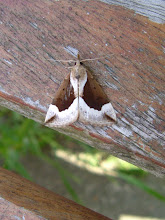
 In contrast to just about everyone else things are very quiet up here in Midgley, just getting singles of odd species, nothing like what most of you guys seem to be getting, I think we might try moving the trap. One other suggestion for our lack of moths has been that they may be getting out of the trap before we have chance to check it, anyone got a solution to this (apart from getting up at 4 am!). The Peppered Moths were on our wall by the trap, is it usual for the two forms to mate? Anyone know enough about PM genetics to be able to say what form the next generation will be?
Saturday, 4 July 2009
Peppered Moths
In contrast to just about everyone else things are very quiet up here in Midgley, just getting singles of odd species, nothing like what most of you guys seem to be getting, I think we might try moving the trap. One other suggestion for our lack of moths has been that they may be getting out of the trap before we have chance to check it, anyone got a solution to this (apart from getting up at 4 am!). The Peppered Moths were on our wall by the trap, is it usual for the two forms to mate? Anyone know enough about PM genetics to be able to say what form the next generation will be?

Subscribe to:
Post Comments (Atom)


12 comments:
The genetic intermediate is f.insularia
great pic,havnt seen any dark forms this year so far,its really useful to record the ratio of each forms anybody gets,as the dark forms are getting fewer and fewer,well certainly round here they are,due to less pollution,thats another fascinating aspect to get into,industrial melanism,B Kettlewell covers the subject in evolution of melanism,theres numerous articles also,Bri.
Ive made the entrance of funnel on trap smaller ,you could buy the same size funnel and cut it so its smaller hole then swap em over if possible on your set up,watch out for birds as they get used to this new food source,great tits, h sparrows have been known to enter traps on occasion,as Adi will vouch for !
Checked around the trap this morning Bri and did find a lot of Moth wings, looks like we might have a bird problem as you suggest!
Not sure of your set up ,a deeper box helps,plenty of egg boxes round the sides as well,if you cant reduce funnel hole size,try somehow bisecting funnel hole with pieces of wire,moths will still get in but not birds,hopefully ! good mothing Bri.
The offspring depend on the genotype of the parents. The typical form is recessive (cc) and the mealnic form dominant (Cc or CC) so the offspring can be a number of different genotypes. The ratios of offspring will let you determine what the parents were. Did you keep the eggs and parents by any chance?
In answer to Andy C above, the insularia morph is determined by a different allele, or possibly several and is not the result of melanic and typical cross-breeding.
Thanks very much for that John.Does that mean that the offspring could not be F.insularia.?
Thats right. There's actually several different forms of insularia that vary from as dark as the melanic to as light as the typical. The original research seemed to suggest at least three different alleles were involved if I remember right.
The offspring of a melanic vs typica crossing should be either 50/50 split melanic and typica or 100% melanic depending on the genotype of the parents.
I've been trying to track down some peppered moths so that I can redo some crosses as a bit of fun. I've got a genetics background, did some undergrad work on peppered moths and am now based in the Zoology Department at Oxford where Kettlewell did a lot of the original work.
Thanks again for that information,I have only recorded the typical form this year in my trap and as Brian has suggested the dark form is becoming scarcer around here.
John,if there is any thing we can do to help your studies,please dont hesitate to ask
Hi Andy,
Thanks for the offer! As you say it seems that the melanic form is becoming a lot rarer recently.
If people were willing to send on some melanic and typica moths that would be really great. I'd be more than happy to repay postage and packing etc.
How often would you say either form of moth is caught nowadays?
John if you could e-mail your e-mail/adress to andrewcockroft@talktalk.net.I can send you an invite to the blogg and we could send whatever you want when we catch them.I have only recorded 15 so far this year with only 2 melanic.
Post a Comment