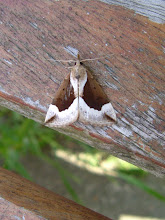
14 x Marbled Beauties of various size and colour this morning. This is a record number of these for me. They seem to like our door.
It looks like they had a party. Judging by their stillness, I think they have hangovers. Been there, done that.
Wednesday, 24 July 2019


Tuesday, 23 July 2019
Uncertain's ?
Two here Colin that I have down for Uncertain (?) if these shots are any help. I've had a few of these recently but the last day or two the ones in the trap have looked faded so then uncertainty creeps in !


Stainland.
On my way to bed when Anne found the following moth in the bathroom. I'll stick my neck out once again. I think this is a White Shouldered House Moth.
Charlie, you once told me that many moth-ers ignored micros, thinking they were beneath them. I think I have news for you. Many find them so hard to ID they get disillusioned and stay with what they feel safe in. I could be turning into one of those people.

Charlie, you once told me that many moth-ers ignored micros, thinking they were beneath them. I think I have news for you. Many find them so hard to ID they get disillusioned and stay with what they feel safe in. I could be turning into one of those people.

White Shouldered House Moth
(Dingy Dowd). TBC

VC 63 Garden Moths Mon 22nd July 2019
VC 63 Garden Moths Mon 22nd July 2019
Breezy intermittent strong . Warm 18 -20 o
Method Actinic 20 W Robinson
Other Entomology
Escalating Temps conducive to all manner
Caddis
Carabid
Orange Spot Ladybird
Mirid
Diptera
ABH 49.294 1175 Bramble Shoot Moth
There are a couple of specimens I'd like a second opinion on . The first I take either to be a Heart and Clubs or just simply an oddly marked Heart and Dart ( collare not deeply marked implying the former ) but poss the H&D
The Second Looks like The Uncertain or less likely Rustic the links below are useful but there is a little wear on the transverse lines


Breezy intermittent strong . Warm 18 -20 o
Method Actinic 20 W Robinson
Other Entomology
Escalating Temps conducive to all manner
Caddis
Carabid
Orange Spot Ladybird
Mirid
Diptera
ABH 49.294 1175 Bramble Shoot Moth
ABH 73.162 2321 Dark Arches Apamea monoglyph >17
ABH 72.045 2050 Common Footman Eilema lurideola >5
ABH 73.317 2089 Heart & Dart Agrotis exclamationis >4
ABH 73.342 2107 Large Yellow Underwing Noctua pronuba. > 10
ABH 63.080 1293 Chrysoteuchia culmellaABH 73.342 2107 Large Yellow Underwing Noctua pronuba. > 10
ABH 73.084 2293 Marbled Beauty Bryophila domestica 3
ABH 73.096 2381 The Uncertain Hoplodrina octogenaria TBC
ABH 69.003 1981 Poplar Hawk-moth Laothoe populi. x2
ABH 73.338 2118 True Lover's Knot Lycophotia porphyrea x1
ABH 73.267 2160 Bright-line Brown-eye Lacanobia oleracea x1
Wed 24th July 2019
ABH 63.018 1378 Anania coronata
ABH 73.156 2326 Clouded-bordered Brindle Apamea crenataABH 73.338 2118 True Lover's Knot Lycophotia porphyrea x1
ABH 73.267 2160 Bright-line Brown-eye Lacanobia oleracea x1
Wed 24th July 2019
ABH 63.018 1378 Anania coronata
There are a couple of specimens I'd like a second opinion on . The first I take either to be a Heart and Clubs or just simply an oddly marked Heart and Dart ( collare not deeply marked implying the former ) but poss the H&D
The Second Looks like The Uncertain or less likely Rustic the links below are useful but there is a little wear on the transverse lines


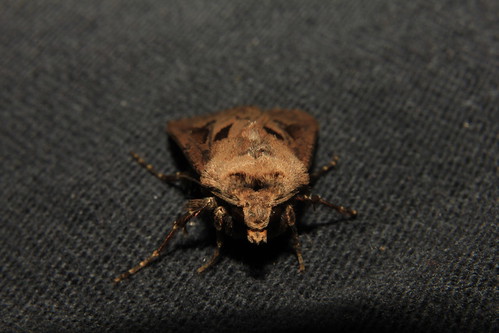
Stainland.
After Colin's observations, I've corrected the entries I misidentified.
Thanks Colin.
Several moths last night. I took these in the small hours, I'd been out of bed for about 6 minutes. For reasons best known to themselves, some of the moths decided to settle at the bottom of the door. I'm still unable to bend my knees far enough to crouch. I certainly would not have been able to lay on the path to take the shots either. So, I'm sorry that some of these photos a soft (blurred!)
Some of these need IDs (if possible) please.
The first one is worn, I couldn't decide what it was.

ID Needed.
Next up is a Eudonia mercurella. There were three of these.

Eudonia mercurella.

Bee Moth.

Chrysoteucha culmella.

Chrysoteucha culmella.

Single Dotted Wave.
Also:
6 x Marbled Beauties.
3 x Blastobasis lacticolella.
Cunnery Wood meadow
Took advantage of the good weather and a site meeting to spend an hour in the meadow above the pond looking for butterflies (then through the woodlands). Not put numbers as there were lots.
Small tortoiseshell
Comma
Meadow brown
Skippers (small)
Ringlet
Burnet moth
Green veined white
Speckled wood
Gatekeeper
Small heath.
Possible purple hairstreaks on one of the oaks.
Battle of the Hairstreaks
On the 19th July 2008 , I found my first White letter Hairstreak in my local wood at Northowram , there is only one Elm surrounded by lots of Oak....for the last 10 years I have looked and looked on the elm for another and i have not seen one.....Until today that is....it was a great day for butterflys one of those days you think of in the depths of winter...5 Commas , 30 + Small Tortoiseshell , 10 Small White , Small and Large Skippers 1 Gatekeeper , Large Whites , Ringlets and Meadow browns in the grass and my first 6 Purple Hairstreaks flitting about in the tops of Oaks. As I got to the said Elm i noticed Hair streaks flitting about. I stopped and started to watch very closely what was going on.
As the Purple Hairstreaks flew over the Elm the White letters flew up and moved the Purples on , (I had obviously forgotten my camera ) , I reckon there were at least 5 White Letter Hairstreaks and 10 Purples flying in the baking hot sunshine along the side of the wood......................
WLH update 17.18
 Spot the Hairstreak
 Always turning to the sun
 Bingo
Bingo
 Headed back to try and get a photo and anyone who has tried to photo hairstreaks knows its not an easy job ......unless they are feeding on thistles .......
White - letter Hairstreaks x 8
Purple Hairstreaks x 12
Red Admiral x 1
Gatekeeper x 1
Holly Blue x 1
Comma x 5
Small Tortoiseshell x 50 +
Small White x 11
Large White x 10
Meadow Brown x 30 +
Ringlet x 20 +
Small Skipper x 1
Large Skipper x 2
Speckled Wood x 3
Silver Y x 1
As the Purple Hairstreaks flew over the Elm the White letters flew up and moved the Purples on , (I had obviously forgotten my camera ) , I reckon there were at least 5 White Letter Hairstreaks and 10 Purples flying in the baking hot sunshine along the side of the wood......................
WLH update 17.18


White - letter Hairstreaks x 8
Purple Hairstreaks x 12
Red Admiral x 1
Gatekeeper x 1
Holly Blue x 1
Comma x 5
Small Tortoiseshell x 50 +
Small White x 11
Large White x 10
Meadow Brown x 30 +
Ringlet x 20 +
Small Skipper x 1
Large Skipper x 2
Speckled Wood x 3
Silver Y x 1
Monday, 22 July 2019
Recent news


A light Arches in Hebden Bridge over the weekend and this fantastic Varied Coronet from Ludunden Village...The top one has been puzzling me for a while but is going down as Minor Sp....
Stainland.
Just one today. A Riband Wave - Non Banded. It was brave enough to face the strong wind up here last night.


Riband Wave - Non Banded.
I really posted this moth as it was at eye height, giving me a good chance to get a close-up showing it's markings.

Riband Wave detail.
Sunday, 21 July 2019
Stainland.
I have corrected the name of what I accidental called a Eudora Lacustrata, to Eudonia lacustrata. Thanks to Charlie for correcting me.
Colin posted a Eudonia with a certain amount of doubt. I have a similar situation. I'm fairly certain the first moth below is correctly ID'd. The second one is the problem. I simply cannot decide if it's the same species as the one above or not. I'm open to correction.
I only discovered this morning, on Norfolk Moths, that the Eudonia lacustrata has a common name; Little Grey. I think that's rather sweet.


I'm putting this next, well-posted-already moth, to draw attention to an observation. For the four or so years that I've been recording moths, the grey/black/white variety of Marbled Beauty, has always appeared before the brown/orange variety and in far greater numbers.

Colin posted a Eudonia with a certain amount of doubt. I have a similar situation. I'm fairly certain the first moth below is correctly ID'd. The second one is the problem. I simply cannot decide if it's the same species as the one above or not. I'm open to correction.
I only discovered this morning, on Norfolk Moths, that the Eudonia lacustrata has a common name; Little Grey. I think that's rather sweet.

Eudonia lacustrata - Little Grey.
(Thanks for the correction Charlie).
(Thanks for the correction Charlie).
So, here is the one I'm not sure of. Norfolk Moths shows that Eudonia lacustrata has a brown version as well as the grey. On the other hand, I can't decide if the markings of it are the same as the Eudonia lacustrata or not. Help please?

Eudonia lacustrata. (TBC).

Blastobasis lacticolella.
I'm putting this next, well-posted-already moth, to draw attention to an observation. For the four or so years that I've been recording moths, the grey/black/white variety of Marbled Beauty, has always appeared before the brown/orange variety and in far greater numbers.
This year, I got one or two grey ones, then suddenly and arriving earlier than before, I had a lot of the orange ones. These have out-numbered the grey, for me at least. The poor weather will have reduced the amount of moths flying, but doesn't explain the whole picture. I suppose we shall never know what happens in these situations.

Marbled Beauty.
Saturday, 20 July 2019
Another Eudonia sp
Open to correction
Not a definitive but an opinion to best practice all naturalists will have there own
ABH 63.067 BF1338 Eudonia lacustrata
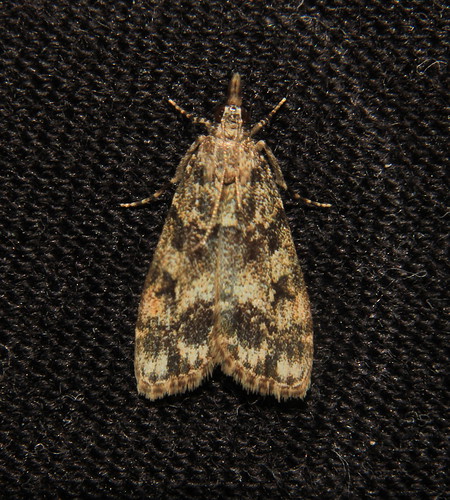
Not a definitive but an opinion to best practice all naturalists will have there own
Scops Often put to the back of the pile or ignored in the Field . I have thrown this post together as a holding page for various specimens as found .
General principles
Scopariinae are a difficult group to identify. Best to document fresh specimens when found as opposed to worn if an option on a catch. Worn moths if there is any uncertainty might best be reflected as Eudonia sp. Mines Rearing and Gen det are other routes to certainty.. Not applicable on Calderdale Moths but it is suprising how many experts sometimes dont validate there own observations.
Validation can include vouchers for Gen Det , Shared Imaging for Confirmation by Experience , Never give an officer a map share the route and get there without hitch . A second opinion never goes amiss , respect others on the journey. The use of Keys see below is usually a good way of whittling down the options but even the best keys sometimes yield ambiguity
Identification in the loose sense can be express to family , genus or species. It can vary with confidence from Certain, to Likely at various levels based on a number of factors including similars , markings , size , foodplants , etc and of course in some moths dimorphism ( male / female differences )
Best to use taxonnomic keys. These links are good pointers to serious Scoppers
Guide to Scoporiinae Keys
General Link
In respect of ground colour there is a great deal of natural variation amongst moths least alone images and it is not alone necessarily a reliable indicator I defer again to the statement Rearing or Gen Det to be absolutely certain
Scopariinae are a difficult group to identify. In some cases it is just not possible from a look or photograph to identify
General principles
Scopariinae are a difficult group to identify. Best to document fresh specimens when found as opposed to worn if an option on a catch. Worn moths if there is any uncertainty might best be reflected as Eudonia sp. Mines Rearing and Gen det are other routes to certainty.. Not applicable on Calderdale Moths but it is suprising how many experts sometimes dont validate there own observations.
Validation can include vouchers for Gen Det , Shared Imaging for Confirmation by Experience , Never give an officer a map share the route and get there without hitch . A second opinion never goes amiss , respect others on the journey. The use of Keys see below is usually a good way of whittling down the options but even the best keys sometimes yield ambiguity
Identification in the loose sense can be express to family , genus or species. It can vary with confidence from Certain, to Likely at various levels based on a number of factors including similars , markings , size , foodplants , etc and of course in some moths dimorphism ( male / female differences )
Best to use taxonnomic keys. These links are good pointers to serious Scoppers
Guide to Scoporiinae Keys
General Link
In respect of ground colour there is a great deal of natural variation amongst moths least alone images and it is not alone necessarily a reliable indicator I defer again to the statement Rearing or Gen Det to be absolutely certain
Scopariinae are a difficult group to identify. In some cases it is just not possible from a look or photograph to identify
This one Looks to me to be one of the more discernible of the Scopariinae, ... Eudonia lacustrata. There are probably 3 when studied can yield a high confidence to ID visually another 63.069 BF1342 Eudonia angustea with its narrow wings and markings being relatively distinctive
ABH 63.067 BF1338 Eudonia lacustrata


Tortrix Moths.
I've just found a good page for IDing Tortrix moths. Some images show the differences between male and female moths, (sexual dimorphism).
I thought this may help some other members here. For me, any help with micro ID is a good thing.
http://www.bettonyb.co.uk/tortrix1.html
Actually the site, is helpful for IDing moths in general. Go to the Home Page (Link below) for the family groups. There is a search box at the top right, in case you are looking for a particular moth.
http://www.bettonyb.co.uk/picture_lists.html
I thought this may help some other members here. For me, any help with micro ID is a good thing.
http://www.bettonyb.co.uk/tortrix1.html
Actually the site, is helpful for IDing moths in general. Go to the Home Page (Link below) for the family groups. There is a search box at the top right, in case you are looking for a particular moth.
http://www.bettonyb.co.uk/picture_lists.html
Friday, 19 July 2019
News about Painted Ladies.
Hi
Many of you will have noticed there are a lot more Painted Ladies this year. Chris Packham has been on the media talking about it, and the big Butterfly Count.:
https://www.msn.com/en-gb/news/uknews/chris-packham-urges-public-to-track-once-in-a-decade-uk-painted-lady-butterfly-invasion/ar-AAEwYx9?OCID=ansmsnnews11
Many of you will have noticed there are a lot more Painted Ladies this year. Chris Packham has been on the media talking about it, and the big Butterfly Count.:
https://www.msn.com/en-gb/news/uknews/chris-packham-urges-public-to-track-once-in-a-decade-uk-painted-lady-butterfly-invasion/ar-AAEwYx9?OCID=ansmsnnews11
Lee Mount - 19th July
First Buff Arches of the year - with two smart looking individuals
A brown looking Marbled Beauty along with six other typical ones
A green looking Broad-bordered Yellow Underwing
An Angle-striped Sallow
2 x Uncertain (I think)
+ a few others...


And another dark moth c18 mm that had me baffled for a while and which I can only conclude is a Turnip Moth (TBC) (they always throw me a bit).
It shows quite a large elongated oval and one one shot I have the kidney mark looks double lobed.
The underside shows a nice clear silver-white under-wing which I also saw from above when it opened its wings. Dark streaks on the abdomen also show nicely though I have not found any other photos of Turnip Moth underside as yet.


A brown looking Marbled Beauty along with six other typical ones
A green looking Broad-bordered Yellow Underwing
An Angle-striped Sallow
2 x Uncertain (I think)
+ a few others...

Broad-bordered Yellow Underwing

Buff Arches

Marbled Beauty

Angle-striped Sallow - oops nearly had it down for and Orange Sallow !!

Uncertain
And another dark moth c18 mm that had me baffled for a while and which I can only conclude is a Turnip Moth (TBC) (they always throw me a bit).
It shows quite a large elongated oval and one one shot I have the kidney mark looks double lobed.
The underside shows a nice clear silver-white under-wing which I also saw from above when it opened its wings. Dark streaks on the abdomen also show nicely though I have not found any other photos of Turnip Moth underside as yet.


Lee Mount - micro ?
Any help with this one appreciated.
I go through them with a tooth-comb, that's if I can get a decent picture in the first place. Not easy, then I give it up - then come back to it.......then most of them I give up on - but I keep trying.
It's so easy to go down the wrong path !!!
Any tips on getting photo's that don't go 'shiny' and distort the colour ?

 Many thanks
Dave
I go through them with a tooth-comb, that's if I can get a decent picture in the first place. Not easy, then I give it up - then come back to it.......then most of them I give up on - but I keep trying.
It's so easy to go down the wrong path !!!
Any tips on getting photo's that don't go 'shiny' and distort the colour ?


Dave
Thursday, 18 July 2019
Lee Mount - 18th July
This one had me puzzled for a while when it landed on top of the trap soon after dusk last night. It had gone this morning but I think I've sorted it now !?


Only ever had one before, on 10th July 2018 - the unexpected is always a bit special.

Small Dotted Buff - 12mm

Only ever had one before, on 10th July 2018 - the unexpected is always a bit special.
Stainland.
I found the moth below in our kitchen and caught it in a sample pot. I was confused as to what it could be, (a rather worn Red-Barred Tortrix) as Manley's states it at 12-18 mm. There is no way the moth was that big. However, looking on line, most sites give it as 6-8 mm, except one, which stated 6-8 mm.
I hope the size error in Manley's was caused by whoever set the text for printing. It would be a shame to think it was Manley. Anyway, I will now always cross reference data about finds. I'm eagerly waiting someone to point out I got the ID wrong, (again).

I hope the size error in Manley's was caused by whoever set the text for printing. It would be a shame to think it was Manley. Anyway, I will now always cross reference data about finds. I'm eagerly waiting someone to point out I got the ID wrong, (again).

Red-Barred Tortrix.
Subscribe to:
Posts (Atom)