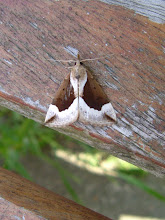
As a continuation of the thread regarding Oak Beauty and its status locally. I recorded a very distinctive and easy to ID micro called Esperia sulphurella. I used to record the odd individual at various places in Calderdale and Kirklees. Always in small numbers, usualy a single individual either at light or netted when out "bush tapping" for micros. It was always in mature woodland or my garden which backs directly into mature woodland. I am very interested in the invertebrates inhabiting dead wood and sulphurella feeds in soft dead wood in the larval stage. I was writing an article for the Amatuer Entomologists Bulletin on dead wood in the garden, and to help with this I built a small log pile in a shady corner of the garden and left this to rot down over a couple of years. I noticed one spring evening that the Honeysuckle in the garden was teeming with E.sulphurella with at least 30 individuals counted on several evenings over the space of two weeks and smaller numbers of up to 10 individuals for a good month or more afterwards. It was obvious that the log pile had large numbers of E.sulphurella larvae which emerged and hung around the Honeysuckle in the vicinity of the log pile. I think in that one small log pile there must have been literally dozens if not hundreds of larvea of E.sulphurella.
Now had I not been writing the article and built the log pile because of my interest I would have made the assumption that this species did occur in mature woodland but only in very small numbers. Andy C and the rest of you would look at my mapamate records and assume that it was around in Calderdale but only in small numbers, when In fact I think it is probably very common in all the mature woodlands around Calderdale. This is one reason why I am cautious about giving the status of a species in Calderdale, we simply do not know in most cases how common or uncommon a species is until at least 10/20 years have passed and we have a number of records to look through from a number of recorders in differant parts and altitudes in Calderdale.
I could list many other species in Calderdale which might be classed as common and well as scarce to illustrate the point that we should be cautious in giving a definate local status for our lepidoptera. Insects are not birds or mammals and given the right conditions can multiply massively in one or two years, record them at this time and we could get the idea that the species is very abundant when it fact it was recorded at the peak of its cycle and is normally around in much lower numbers most of the time.
I have an even more astonishing record of a Cranefly which had only been recorded around 6 or 7 times since 1970 in Yorkshire which emerged in huge numbers every spring from the same dead wood in my garden. Roy Crossley from the YNU who ID the fly for my had surveyed park Wood in the previous years and not found a single individual. My garden used to produce around 100 + individuals each spring so its was obviously common in suitable habitat and the correct time of year ! Roy had never considered the species as scarce nor as abundant but as probably under recorded which I think is the correct assumption based on the evidence from my garden.
I can list several species I think would benifit from a few recorders pooling their records and making a targetted attempt to find them in the next few years if this is of interest ? I am moving out of the area shortly but will be supply all my records to Andy C when I get the time.


.JPG)


.JPG)