I 've been tripped up twice with moths in the last couple of weeks, so I'm asking two quesions;
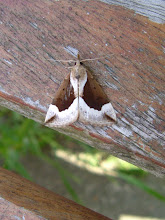
1) Is the moth below, a Winter Moth? If so, it's another first for me.
2) How the devil do moths know what they look like, to enable the to chose the best camouflage surface near them? After all, they don't have little mirrors. Er... they don't, do they?

Winter Moth. TBC.



2 comments:
Hi Gordon
You have a November Moth Agg. There. For Q2 I think that like with food plants I expect it's hereditary from parents that moths know which colour they are. I think.
Thank you Edward, for both replies. I have heard the explanation about hereditary information several times. The trouble with it is, for me, if that is true, how did the first parents know what they looked like? As a biologist and the say, "Oh, that's easy. Natural Selection." At which point I laugh.
Take mitochondria. One of them mutates, it's a beneficial mutation. It needs another mutation like type to carry that genetic code on. So, the first mutation looks around among untold millions of mutations, on the off chance it can find another like it. How likely is that? That's the Natural Selection argument in a nutshell. It sidesteps the issue by fobbing everyone including themselves very clever. I'm not getting at you, please don't think I am. I simply wish more biologists would say, “ Short of a God doing it, we don't yet know”. A little honesty would go a long way. I had arguments with my tutors when I was studying. They would suddenly say things like. “A perfect gas would behave like this, so we calibrate all gasses on the model for a perfect gas”. I would say, “as a perfect gas does not exist, your calculations are at best incorrect and misleading, no such gas exists. At worst, they're based on a lie.” It was never resolved. Ha! A deep subject, and a hobby horse of mine, sorry Edward.
Post a Comment