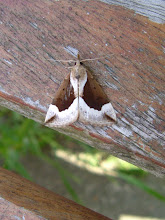
Just going through some old photos and came across this moth. I found it down at Cromwell Bottom on 17th June 2007. Can anyone help me ID it?
Saturday, 29 November 2008
Moth for ID
Just going through some old photos and came across this moth. I found it down at Cromwell Bottom on 17th June 2007. Can anyone help me ID it?
Friday, 28 November 2008
Angle Shades
Tuesday, 25 November 2008
Friday, 21 November 2008
Silence of the Lambs moth find a mystery
South Yorkshire daily Star November 1st 2008
By Staff Copy,via Yorkshire Moths and my Dad
AN EXOTIC visitor from far, far away is providing a perplexing puzzle for staff at Sheffield's Botanical Gardens.
Gardeners have found a rare Death's Head Hawk Moth – a giant of its kind famous for featuring in the blockbuster chiller The Silence Of The Lambs.
The seven centimetre moth – which can boast a wingspan of up to 13 cms when fully grown and is the largest species ever seen in the UK – was found dead in the glass pavilions.
It was taken to moth enthusiast Ed Kelly, who owns the Gatehouse Gift Shop at the gardens, for identification.
Ed called in Sheffield University etymology expert Richard Naylor, who was equally baffled by the exotic immigrant.
The sinister-looking creature's natural habitat is in southern Europe, and how one ended up in Sheffield is a mystery.
Ed said: "To see a moth like this is an incredibly rare event.
"Richard said they are sometimes blown here across the Channel but only a few arrive each year and they never breed here."
Specimens making it into the UK are sometimes found in southern England, but hardly ever make it north.
Ed added: "Richard wondered if it had been transported here in one of our plants or in the soil, but we've had no recent deliveries like that.
"It looks like it has just emerged from its chrysalis but has died perhaps because it is too cold.
"It is a bit gruesome – it has the distinctive skull marking on its back."
The moth will be on display in Ed's shop for the next few days and will then be donated to the university.
By Staff Copy,via Yorkshire Moths and my Dad
AN EXOTIC visitor from far, far away is providing a perplexing puzzle for staff at Sheffield's Botanical Gardens.
Gardeners have found a rare Death's Head Hawk Moth – a giant of its kind famous for featuring in the blockbuster chiller The Silence Of The Lambs.
The seven centimetre moth – which can boast a wingspan of up to 13 cms when fully grown and is the largest species ever seen in the UK – was found dead in the glass pavilions.
It was taken to moth enthusiast Ed Kelly, who owns the Gatehouse Gift Shop at the gardens, for identification.
Ed called in Sheffield University etymology expert Richard Naylor, who was equally baffled by the exotic immigrant.
The sinister-looking creature's natural habitat is in southern Europe, and how one ended up in Sheffield is a mystery.
Ed said: "To see a moth like this is an incredibly rare event.
"Richard said they are sometimes blown here across the Channel but only a few arrive each year and they never breed here."
Specimens making it into the UK are sometimes found in southern England, but hardly ever make it north.
Ed added: "Richard wondered if it had been transported here in one of our plants or in the soil, but we've had no recent deliveries like that.
"It looks like it has just emerged from its chrysalis but has died perhaps because it is too cold.
"It is a bit gruesome – it has the distinctive skull marking on its back."
The moth will be on display in Ed's shop for the next few days and will then be donated to the university.
Wednesday, 19 November 2008
Sugaring Caution
Hi all
Not meant to be scaremongering but please be very, very careful should you decide to boil up your own sugaring mix. As you have to dissolve sugar and the mix turns into the equivalent of runny jam its very very hot when boiling (like jam it boils at a higher temp than water)and it tends to boil over if not watched and it tends to spit and splash out of the pan. If it lands on bare skin in the hot state it sticks like napalm and burns just as badly. Its got a wonderful appetising scent like sweet toffee and is irresistible to kids and pets so must never be left unattended until its cool for obvious reasons.
Second point and this request has been made many times in other forums. Please do not spread the mixture on trees with mosses and lichens on the bark as it kills the moss and lichen and thus spoils the biodiversity of the tree and spoils it for other people who prefer mosses and lichens to moths as a hobby.
Not meant to be scaremongering but please be very, very careful should you decide to boil up your own sugaring mix. As you have to dissolve sugar and the mix turns into the equivalent of runny jam its very very hot when boiling (like jam it boils at a higher temp than water)and it tends to boil over if not watched and it tends to spit and splash out of the pan. If it lands on bare skin in the hot state it sticks like napalm and burns just as badly. Its got a wonderful appetising scent like sweet toffee and is irresistible to kids and pets so must never be left unattended until its cool for obvious reasons.
Second point and this request has been made many times in other forums. Please do not spread the mixture on trees with mosses and lichens on the bark as it kills the moss and lichen and thus spoils the biodiversity of the tree and spoils it for other people who prefer mosses and lichens to moths as a hobby.
Hints on Sugaring
This is taken from the excellent 'Practical Hints for the field Lepidopterist'by J.W. Tutt,a good x-mas present to yourself and can be got from Pennine Books(link on the right of screen) run by P.Talbot.Also the new edition of Skinner is out soon.
Sugaring should be attempted side by side with sallowing. It sometimes happens that when sallows are unattractive moths may be taken at sugar, and vice versa. We are indebted to Alderson for some excellent notes on "sugaring" (Ent. Rec., i., p. 140). He states that he always uses coarse brown sugar, when procurable, but has found old black treacle quite as effective. Blackberries, gathered when ripe, and boiled down with sugar, form an excellent substitute, and is especially attractive to the Xanthiids. When laying the sugar on, it is advisable to add a little rum (methylated spirit, jargonelle, and other substitutes are also used by various collectors), every dozen trees or so, rather than to mix the whole previous to starting. It is also desirable to commence in sufficient time to allow finishing the last tree on the round before dusk, the first hour being as a rule the most productive. A long thin line (the width of the brush) almost to the foot of the tree is better than a small patch, one advantage of the former method being that the insects are not clustered so closely, and fewer escape, especially if one commences by throwing the light first at the bottom of the tree. On a windy night the majority of the moths are frequently on the lowest part of the sugar, the upper portion being almost deserted, whilst those Noctuids that fly nearest the ground are much more likely to be attracted. It is also always worth while to sugar a quantity of small-limbed trees, as these frequently pay well when the bare trunks of large trees are little patronised. It is advisable, too, to shake the brush over low-growing shrubs, and also to carefully let a drop of sugar fall on the centre of thistle and other composite flowers, or to sprinkle a little over the flower-heads of Eupatoriur. Be careful also to keep at work on the same ground, the moths appear to congregate more on a round that is continually worked, and the trees kept constantly sugared. Changing ground does not usually prove particularly productive, especially for the first few nights, besides, the fact that more sugar is required on a new round is important, an old round wanting very little to freshen it up. Boxes should always be ready when renewing old sugar, as many species, early on the wing, will be found already at the bait, and, the spirit having evaporated from the latter, these early-comers are usually exceedingly wary.
RECORDS PLEASE
Hi all,If any one has there records ready for this year(2008) could they please send them to me at my e-mail adress Thanks to those who have allready sent them in .Andy
Tuesday, 18 November 2008
Red sword Grass
2 Red Sword Grass recorded at sugar last night in Todmorden from a new site also 8satellites,Chestnut and yellow line Quaker,from a new recorder called Marolyn.
BBC i player
http://www.bbc. co.uk/iplayer/ episode/b00fj265 /Inside_Out_ South_West_ 121
A small bit on a moth trapping session on i-player,if this link does'nt work you will av t cut and paste
Monday, 17 November 2008
News from todmorden over the weekend
1 Feathered Thorn
9 Red Green carpet
1 Juniper Carpet
10 Chestnut
14 Satellites
3 Brick
1 angle Shades
2 Yellow Lined Quaker
6 Light Brown apple Moth
Again Brian proves there still out there in good numbers.!
I had 1 Chestnut and 2 Light Brown apple moth up here but I think Wenesday looks ok this week.
9 Red Green carpet
1 Juniper Carpet
10 Chestnut
14 Satellites
3 Brick
1 angle Shades
2 Yellow Lined Quaker
6 Light Brown apple Moth
Again Brian proves there still out there in good numbers.!
I had 1 Chestnut and 2 Light Brown apple moth up here but I think Wenesday looks ok this week.
Wednesday, 12 November 2008
Only House wood/Northowram
Just about manage to sugar a few trees this evening before it got too dark ,-
1 Red Green carpet
3 Chestnut
1 Satellite(orange spots)
1 Red Green carpet
3 Chestnut
1 Satellite(orange spots)
Saturday, 8 November 2008
Last nights moths
Another productive night at Mv light in Todmorden with Brians first Scarce Umber of the year,he also recorded Winter moth ,Mottled umber,Common Marbled carpet,Red Sword grass in Northowram I recorded 30 moths of 8 species with my first 'white spotted' Satellite,despite the wind it was a good night.
Thursday, 6 November 2008
Wednesday, 5 November 2008
News from todmorden
Brian recorded the following at his Mv125 last night in Todmorden
13 Red Green carpet
1 autumn Green Carpet
1 red sword Grass
1 feathered thorn
1 blairs Shoulder Knot
1 yellow line Quaker
1 Light Brown apple Moth
and 2 Torts to id
13 Red Green carpet
1 autumn Green Carpet
1 red sword Grass
1 feathered thorn
1 blairs Shoulder Knot
1 yellow line Quaker
1 Light Brown apple Moth
and 2 Torts to id
Tuesday, 4 November 2008
Last Night's 3 visitors
Mondays moffing
Thursday, 30 October 2008
Horse Chestnut Leaf - Miner

Derek Parkinson recorded 366a Horse Chestnut Leaf-miner Cameraria ohridella at Norwood Green over the weekend,this is the first record of this species in Calderdale.Many thanks to Derek for this information.This pasage below and Photo are taken from the excellent UKmoths site ......-
This species was discovered near Macedonia in 1985, and since then has spread rapidly to other countries in Europe. It was first discovered in Britain at Wimbledon in south-west London in 2002, but possibly had arrived the previous year, as it was quite plentiful. It is thought that the species may be expanding partially due to accidental transportation by man, either by road or rail. It has now been found quite extensively in the south-east of England.
The larva mines the leaves of horse chestnut (Aesculus hippocastanum) causing noticeable brown blotches, often many to one leaf. There is however, a similar-looking fungus which can cause confusion.
The adult moths resemble other Gracillariidae, although are quite distinctively dark reddish-brown with a noticeable white frons. It is thought that three generations exist.
Many thanks to UKmoths and Derek for this info.
Sunday, 26 October 2008
Sugaring at Gorpley Clough(sunday eve)
Rain,high winds and clearing skies didn't make us feel very optimistic as we sugared the trees at Gorpley Clough ,but as the light faded we were soon recording moths..
15 Chestnut
11 Brick
4 Satellite
2 Winter Moths
2 Yellow Line Quaker
1 Angle Shades
1 Red Sword Grass
A real cracking evening and well worth the effort,good to see Brian and photo's to follow from Charlie
15 Chestnut
11 Brick
4 Satellite
2 Winter Moths
2 Yellow Line Quaker
1 Angle Shades
1 Red Sword Grass
A real cracking evening and well worth the effort,good to see Brian and photo's to follow from Charlie
Baffled Butterflies

'click on text above to read'
Another interesting article from the latest BCYB by H.Frost, Argus no 55 showing another reason for population crashes in Butterfly populations.It was a poor year for most species in Calderdale except the Browns with the best ever year for Ringlet and good numbers of Meadow Brown,Speckled wood and the ever increasing Gatekeeper.This was mirrored in the rest of Yorkshire.I think I only saw 4 Painted Ladys in the whole year.?Many thanks for all the new photos in the gallery its looking quite a good reference source now.
Friday, 24 October 2008
Parasitica
Following on from Charlie's superb series of photos of the parasites on the LBAM larva I thought I would make a plea for others to post any images they record and keep both the remains of the larva and an adult of whatever parasite emerges. I have the contact address of Dr Mark Shaw at Edinburgh University who is one of the foremost experts on parasitica in the UK. Mark is always grateful for any specimens with data that you can collect for him. He will often be able to name the parasite and let you know details about it. He also uses the specimens sent as voucher material in the university collection, so you will be contributing to our long term knowledge of the parasitica collected. I obviously do not want to post Marks details on the web, but you can contact me via the blog or email for the details
As an example of how useful specimens from Calderdale can be; I used to pot up any adult parasitica I found in my moth trap and pop em in the freezer to store them. Once a month I would put all the parasitica collected into a specimen pot of a alcohol and send them off to Mark. He used all the specimens he could ID as voucher specimens in the uni collection for others to study. The specimens from Calderdale were even more useful in the fact that they came from a more northerly aspect of the UK than most specimens in the collection which in the main came from the SE of England. Several differences where noted between the Calderdale and the other specimens in terms of size and other minor details that had not been noted before in descriptions. In fact one species (whose name escapes me at the moment) was in fact THREE time larger than any other specimen of this species that Mark had seen and he had no idea thay could grow to this size. Several of the specimens I sent had not been recorded from Yorkshire before, so they also contributed to the known distribution. For those who might interested in knowing more about the parasitica Mark has written a small inexpensive book for the AES about them.
When rearing larvae I find that quite a high proportion of then have been got at by some parasite or other and in many cases you have no idea until the parasites emerge from the larva or pupa. I had an ichneumon emerge from an Elephant Hawkmoth pupa once spring which frightened the hell out of me when I opened the pot expecting to see an adult Elephant Hawk only to be confronted by a bloody enormous black and white and very angry inchneumon from which I fled at a rapid rate ! I also used to get lots of a particularly nasty Tachinid fly from Northern Egger larva. The egger larvae used to feed up as normal but them just as they were moving around the tubs seemingly getting ready to pupate they would suddenly stop moving and out would wiggle dozens of small white maggots eating their way out of the by now hopefully dead larva. In about 20 mins the larva went from a seemingly happy healthy Egger to a empty bag of skin.I have some photos somewhere of these maggots munching their way out and will see if I can find them and post them on the blog
As an example of how useful specimens from Calderdale can be; I used to pot up any adult parasitica I found in my moth trap and pop em in the freezer to store them. Once a month I would put all the parasitica collected into a specimen pot of a alcohol and send them off to Mark. He used all the specimens he could ID as voucher specimens in the uni collection for others to study. The specimens from Calderdale were even more useful in the fact that they came from a more northerly aspect of the UK than most specimens in the collection which in the main came from the SE of England. Several differences where noted between the Calderdale and the other specimens in terms of size and other minor details that had not been noted before in descriptions. In fact one species (whose name escapes me at the moment) was in fact THREE time larger than any other specimen of this species that Mark had seen and he had no idea thay could grow to this size. Several of the specimens I sent had not been recorded from Yorkshire before, so they also contributed to the known distribution. For those who might interested in knowing more about the parasitica Mark has written a small inexpensive book for the AES about them.
When rearing larvae I find that quite a high proportion of then have been got at by some parasite or other and in many cases you have no idea until the parasites emerge from the larva or pupa. I had an ichneumon emerge from an Elephant Hawkmoth pupa once spring which frightened the hell out of me when I opened the pot expecting to see an adult Elephant Hawk only to be confronted by a bloody enormous black and white and very angry inchneumon from which I fled at a rapid rate ! I also used to get lots of a particularly nasty Tachinid fly from Northern Egger larva. The egger larvae used to feed up as normal but them just as they were moving around the tubs seemingly getting ready to pupate they would suddenly stop moving and out would wiggle dozens of small white maggots eating their way out of the by now hopefully dead larva. In about 20 mins the larva went from a seemingly happy healthy Egger to a empty bag of skin.I have some photos somewhere of these maggots munching their way out and will see if I can find them and post them on the blog
Subscribe to:
Posts (Atom)