


Hi All
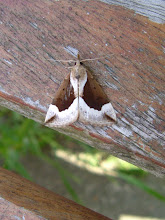
A clear cool but dry night resulted in 1 Mottled Umber and 3 Epiritta sp. To try and confirm or otherwise a November Moth I have tried to get a pic of the abdominal detail (with poor results im afraid) doesnt seem to relate to the pics in W &T however? Could this be a female therefore?



4 comments:
Winston,I think you have a male there - the claspers appear as those two darker brown things at the very end of the abdomen in the top photo.It's no good photographing the abdomen,you'll need to get stuck in and gently brush away the scales on the last abdominal plate - the one above the claspers.Then measure the distance between the two tooth like projections of the plate.You'll need a hand-lens to do this, and something to "subdue" the moth - good luck!
I see. I rather stupidly I forgot that the females are flightless. Might be worth looking for some on an apropriate night (again) as here I get lots of epirritas and there are not many trees on the other side of the canal which makes me think the females must be on the nearby trees (I can hope at least)The main thing of interest in your reply is the fact that the relevant details of the abdomen are obscured by scales, didn't know that. thanks. Win
Win,
All the epirrita females are fully winged and capable of flight - you must be thinking of the "winter" moths and umbers I reckon!
I think until you get used to "looking" at their reproductive bits and abdominal plates it can be quite daunting and not as straight forward as you might think.
doh, yes you were right Charlie. I was lumping them in with the other winter species. Thanks
Post a Comment