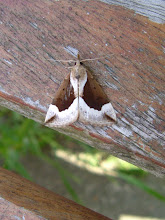
There are several different forms with varying colours depending on the climate in which the larvae grow
f. nigricans
F, palida The pale form f. pallida, is considered to have developed in warmer climates before migrating to the cooler Uk.
f. gammina is smaller and can be found in most year and thought to be a result of starved caterpillar although this is in dispute
ab. bipartita
ab gartneri
ab gartneri
I cant find much descriptive detail on the forms of Silver Y but it would be interesting to review what forms have been recorded in Calderdale historically over the quiet months
There are many different forms of this species. The most common is grey, but some are brown, or purple tinged. If the moth is very pale, this is due to a hot climate (form pallida). There is also a small form (form gammina) which is probably due to little feeding as a larva. There is also a black form (form nigricans), though the Y mark is still prescent. There are two rare forms which affect the Y mark; Form gartneri has the Y mark greatly enlarged, and the form bipartita has the Y mark seperated, quite similar to that of the Ni Moth.

The form f. gammina can be up to half the size of other forms
I'll update the post with anything relevant



1 comment:
I'm unsure as to whether you meant this your or last year in this post. However, in 2015 I posted a dark form Silver Y (chocolate brown) on the 17th Nov.
On the 26th, Nov. I posted a light grey/brown. Both are on the FEET blog. Probably not the info you were after, but I thought I'd mention it, just in case.
Post a Comment