Monday, 5 May 2008

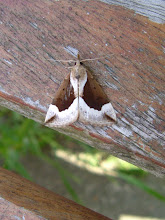
465 Plutella porrectella


Spotted one of these at altitude today whilst out mountain biking. It was in a grass verge above Sowerby near to Crow Hill. The larvae feed on Dame's violet (Hesperis matronalis) and are usually on just about any patch you find

Help with Pugs

Can anyone help me with the i.d. of these two Pugs, both caught on Saturday night, I think one is a Brindled Pug and the other Double-striped Pug. The Brindled was much larger than the DSP, although they both look very similar

Double-striped Pug (?)

Brindled Pug (?)

Saturday, 3 May 2008

ogden

large white
2 small tortoiseshells
1 peackock

Friday, 2 May 2008

Twenty-plume Moth (Alucita hexadactyla)


Lots of the adults of this species around in my garden on Honeysuckle at the moment. Anywhere in Calderdale that has Honeysuckle (including cultivated forms in gardens etc) should have adults on it now. I watch this species every year in the garden at this time on my various Honeysuckle cultivars. The life stages are easy to find and its especially easy to find as larvae over the next few weeks. All you need to do is find Honeysuckle in Flower and look for either a hole chewed in an unopened flower or look for an unopened but rather dirty off white looking flower (caused by the larva's frass).


Ben Smarts image shows the damage rather well.

North Dean Woods

Anyone up for a daytime trip round North Dean next week ? Evenings are not good times for me as I usually get a lot of customer enquires in the evenings and thus its my busiest time of day. In North Dean by next week (assuming the warm weather holds up) I would expect to find quite a lot of different larvae, some Coleophorid cases and perhaps the first leaf mines of the seasons.

I have a couple of hand nets, a sweep net and most of the other gear needed to mount a decent search. As I travel by cycle usually I would appreciate a lift if anyone else fancies coming along. Any day is fine by me, morning or afternoon.

Butterflies so far

Its been a slow stat compared to last Aprils record temps but at last there seem to be a few butterflies about.Comma,Speckled Wood ,Small Tortoiseshell,Peacock and Orange Tip have been seen this week at Cromwell Bottom and there have been a few reports of Brimstone from the Todmorden area.I am almost sure I saw a Green Hairstreak fly by at Ringstone this morning but I could not relocate it.

Cromwell Bottom Map


Andy has given me a map of Cromwell Bottom. I have scanned it and put it up here so people can refer to it and the areas mentioned in various posts on this blog. If anyone wants a better copy I can email it to them if they supply their email address.

Winston

Thursday, 1 May 2008

Sunday

Sunday night looks good for Cromwell Bottom/Copley woods if anyone is interested.

Wednesday, 30 April 2008

Cromwell Bottom Today. 30th April


Called in at Cromwell Bottom on the way home from work today. Saw 5 Peacocks, this one looking interested in a house brick, 3 speckled woods looking fresh and chocolate brown and a whole host of Eriocrania Subpurpurella.

Winston

Tuesday, 29 April 2008

Plantain Leaves

Found my first signs of possible Aspilapteryx tringipennella today in Hebden Bridge after being shown what to look out for in Pauls Post. (Thanks Paul) will try to rear through.
Winston

Butterflies


10 peacock,4 small tortoiseshell and my first male orange Tip today at Cromwell Bottom.

Sunday, 27 April 2008

A few Moths from a Pellon garden

At last spring has finally arrived and last night (Saturday) was a good one with,

Early Grey
Hebrew Character
Common Quaker
Twin Spotted Quaker
Red -green Carpet
Silver Y
Brindled Pug and
Early Tooth-striped

Red-green Carpet


Early Tooth-striped


Early Grey

Brindled Pug

Thursday, 24 April 2008

Micro for Id


Tawny Pinion Lithophane semibrunnea


I been hopeing for one of these for the last couple of years,they were first recorded in Yorkshire at Spurn in 1984 and in VC63 in 1997 at Wintersett and have been becoming more widespread each year.i carnt find any other Caldedale records but there must some.??

Wednesday, 23 April 2008

caterpillar

found 1 wlaking home from school.
wooly bear (i think)

Micro for Id

Cromwell Bottom last night


Well it was nice to meet Charlie and Winston at CB last night but there were few moths about .We found plenty larvae on Ribwort Plantain by the weir and found a very nice V-Pug(pic).A micro to id and a few that got away.hebrew Character ,Twin spot and Common Quaker + early Grey at Northowram.See you all there next week.

Tuesday, 22 April 2008

Test photo


Had small tortoiseshell and Peacock today in and around the garden.

Monday, 21 April 2008

Tuesday,Cromwell bottom

Hi all,lets meet at the car Park by Crowther Bridge at 7ish,I will pop down and sugar a few trees , I am sure PT can tell us some good spots to have a look at Tag Loop and Tag cut should be good.The wind seems to be easing and the temp improving.

Thursday, 17 April 2008

April Larval Tips 3 Cocksfoot Moth Glyphipterix simpliciella


I found lots of the larval signs of this species at Cromwell Bottom this morning. I would probably have given this out as a winter tip this year but as its still so cold the adults will not yet have emerged. In practice one looks for the tall brown steams from last year in the middle of a clump of Cocks Foot Grass (Dactylis glomerata), and searches for the small emergence holes bored by the larvae for ease of emergence as an adult. I did not take and open any of the stems this morning as I have reared this species through before. If you wish to rear some through, all you need to do is cut some stems well below the holes and stick them upright in a lump of florists oasis in some sort of clear container with a mesh top (pop socks) and await the adults.

The adults will be around shortly once the weather warms up and its usualy dead easy to find them on any yellow flowering plant such as buttercups or dandelions. Just to make my "tips" clear, they are not "my tips" anymore than anyone elses, I have simply read up and gone out looking, most of the tips will have been available since Victorian times so they are not "mine".

PS I note a distinct lack of postings on this blog at the moment, there are absoloutely loads of moth species you can find even in a spring as poor as this one, as long as you do not rely on light trapping alone, so come on people lets have some posts from those prepared to have a 10 min walk to find larvae or pupae.Moss, lasts years dried stems and seed heads are stuffed full of goodies at this time of year if you are prepared to look.

Tuesday, 15 April 2008

April Larval Tips 2..On Nettles


Two very common micros on Nettle as larvae now are; 385 Anthophila fabriciana and 1405 Mother of Pearl Pleuroptya ruralis. Which just goes to show how silly the so called division between "macros" and "micros" is , A.fabriciana is very small and P. pleuroptya is as big or bigger than many macro moths, yet both are classed as micros !
I found plenty of spun together nettle tops this morning with both larvae in residence. It can be quite hard to separate the two as fabriciana (bottom photo) do not look as clearly marked as the ones shown from Ian Kimbers website. Both larvae are small and light green in colour in the early instars and only separate out to distinctive larvae as they get to the last instars. The easiest way to separate them by eye alone is that Mother of Pearl (shown in the top photo) are larger and a more translucent green, hard to describe but easy once you have seen both. At the moment the larvae are usually in the growing tips of very small nettles but as the plants grow the larvae tend to be found anywhere on the plant in a leaf spun closed. Lots of other species use nettle in this way later in the year but now I think you will only find the to species mentioned. Should you wish to rear both species they are dead easy, simply add fresh nettles leaves to the container as the old leaves shrivel and the larvae will move to the new leaves to spin up and feed. As a general rule for all larvea at this time of year look for trees or plants that get plenty of sunshine as these tend to be the first ones with larvae whilst its still cold.

Monday, 14 April 2008

April Tips on Sallow

If you have a garage or outside shed, etc, now is the time to start collecting Sallow catkins which have fallen on to the ground from the Sallow trees. Many of these fallen catkins will often contain various Tortricidae, Geometridae and Pug larvae. The way to check the catkins for larvae is very easy. Simply spread them out on white kitchen roll in some seed trays or similar, no need for any sort of lid at this stage. If you keep checking the catkins you will see signs of frass appearing on the white kitchen roll under the occupied catkins. Once you find these move them to a lidded container and keep an eye on the situation. The larvae may need fresh catkins adding and then as soon as the sallow leaves are out pop some leaves in the tub with the occupied catkins. Some catkins will have only one species and some will have more than one species on/in them. Most of these are fine kept together until they are large enough to ID. The only exception to this are Pug larvae which I find are mostly cannibalistic even when enough food is present, if you want more than one survivor its pays to house pug larvae in solitary confinement ! Its great fun with catkins at this time of the year as you never know what you might find and rear through.

We are now getting close to the one of the best times of the year to find moths on natural food sources. Any night now when its cloudy and reasonably mild its the time to go "Sallowing". This is one of the great classic tecniques used before the advent of MV lights to collect large numbers of moths in one place. Cromwell Bottom is an ideal place to try this out but any area with large numbers of Sallow in bloom is fine. You simply stick a few pots in your pocket, pack a decent torch and a butterfly net. In practice one simply walks around shining the torch on Sallow catkins until you pick out a moth feeding, they can usually be spotted by the light reflecting off their eyes. One a good night there can be hundreds of moths on each Sallow bush, but often around here one is lucky to get a few dozen per bush. If its moth sp you wish to confirm or look through a hand lens its usually dead easy to simply pop the net over them and tap them off the catkins. They are mainly Orthosia spp, but also Chestnut, Satellite, perhaps some Thorns and Pugs. The only other time of year when one can get the same effect with natural sources is in autumn when you search Ivy Blossom in the same manner.

Assuming that at various points over May I will still be around Calderdale during the week is anyone intersted in some daytime larval beating sessions at this time ?

Sunday, 13 April 2008

April Larval tip 1...Aspilapteryx tringipennella


I shall now post some tips of what to look for in the coming weeks as and when I get the chance depending on work and my move to Wales. Most of the tips will be related to the larval stages of micros as that is my own entomological passion. All will be of species I have found previously in Calderdale or I expect to be found in Calderdale. Its would help records for the area if people do have a look for these as in many instances I may only have found them near my home in Elland and have no idea of their distribution or otherwise in Calderdale.
The larva should now be around in some numbers in the next few weeks of Aspilapteryx tringipennella in Ribwort Plantain (Plantago lanceolata), a very common "weed " of waste ground throughout Calderdale. As can be seen from the photo (courtesy of Ian Kimber) the larvae which have over wintered in the rootstock of the plant are by now spinning closed the plant leaf near the midrib causing it to close and form a "blister". Should you gently pull open one of these you will either find a larva feeding or a pupa. If you look at the bottom of the blister and see a small hole it means the adult has emerged. If the hole is covered with fine silk it means the pupa is still inside. The adults emerge through these pre-chewed holes when they emerge. This is a very easy larvae to find as I suspect it will occur right through Calderdale wherever the plant occurs. Look first on dry sheltered spots that get at least some sunshine in early spring. I will be amazed if you do not find it.

I used to have a favourite patch of Ribwort Plantain at Cromwell Bottom on Brookfoot loop. I used to bag this species every year first in this spot. Unfortunately its now been either dug up or buried under spoil from the 4 metre wide track being created around that part of the LNR. Even more ironically the one spot in all Calderdale in which I could guarantee to the males of Ghost Moth "leking" every year awaiting females was also in the now destroyed spot previously mentioned . This is even sadder as Ghost Moth is a LBAP species in Calderdale and its not been even protected on a Nature reserve !
So in one area of a LNR which is supposed to be protected and monitored we have lost colonies of:
Aspilapteryx tringipennella
Ghost Moth Hepialus humuli
Leucoptera spartifoliella

Friday, 11 April 2008

A poor week

Cold nights and wind and rain have made for a poor week.
1Aspilapteryx tringipennella
3 hebrew character
1 Early Grey
Bri had 5 satellite , 2 Chestnut and a Mottled Grey
Nowt else to report

Saturday, 5 April 2008

Another Plume


1Emmelina monodactyla,(pic)6 hebrew Character,Early Grey(first of the year about 1 month later than last year)and another Orange Underwing yesterday at Cromwell Bottom

Friday, 4 April 2008

Oak Nycteoline


Brian Leesey phoned me today to let me know he had recorded 2423 Oak Nycteoline last night (I think it was last night). I have recorded this in most months of the year (March-Nov) in Calderdale but only as singletons at light. A seemingly scarce species in Calderdale, but given the recent thread on the forum is it scarce or just overlooked ? Its actually one of the Noctuidae but due to its small size is often ignored as a large Tortrix which it resembles closely to the naked eye. It a very variable species but most specimens I have trapped have had very distinctive dark spots on the forewings (as had Brians), much "crisper and brighter" looking all over than the one shown (borrowed from Ian Kimbers site).

Thursday, 3 April 2008

Unknown Eriocrania

This Eriocrania species appeared last night in the light trap, anybody able to tell which one it is? (sorry the photo is rather poor)


Last Nights moths


1 Small Quaker,3 hebrew Character,2 common Quaker,1 brindled pug,2 Clouded Drab and this dactyla sp,which i will have to look up ,as i am off for a couple of days.?

Wednesday, 2 April 2008

Sunday 1st Butterfly

Sorry for late post but saw my first butterfly at the bottom of the path near the style that leads up through Avocet Wood, sp. Comma - photo's to follow.

Recent visitors

The following visitors have been attracted to the skinner trap over the last few days -

Red Sword-grass
Hebrew Character (Pictured)
Clouded Drab
Common Quaker
Small Quaker
Diurnea fagella (Melanic Form)
Pug Species (Pictured)

can anyone help me with this last one?


Sunday, 30 March 2008

Target the Species


As a continuation of the thread regarding Oak Beauty and its status locally. I recorded a very distinctive and easy to ID micro called Esperia sulphurella. I used to record the odd individual at various places in Calderdale and Kirklees. Always in small numbers, usualy a single individual either at light or netted when out "bush tapping" for micros. It was always in mature woodland or my garden which backs directly into mature woodland. I am very interested in the invertebrates inhabiting dead wood and sulphurella feeds in soft dead wood in the larval stage. I was writing an article for the Amatuer Entomologists Bulletin on dead wood in the garden, and to help with this I built a small log pile in a shady corner of the garden and left this to rot down over a couple of years. I noticed one spring evening that the Honeysuckle in the garden was teeming with E.sulphurella with at least 30 individuals counted on several evenings over the space of two weeks and smaller numbers of up to 10 individuals for a good month or more afterwards. It was obvious that the log pile had large numbers of E.sulphurella larvae which emerged and hung around the Honeysuckle in the vicinity of the log pile. I think in that one small log pile there must have been literally dozens if not hundreds of larvea of E.sulphurella.


Now had I not been writing the article and built the log pile because of my interest I would have made the assumption that this species did occur in mature woodland but only in very small numbers. Andy C and the rest of you would look at my mapamate records and assume that it was around in Calderdale but only in small numbers, when In fact I think it is probably very common in all the mature woodlands around Calderdale. This is one reason why I am cautious about giving the status of a species in Calderdale, we simply do not know in most cases how common or uncommon a species is until at least 10/20 years have passed and we have a number of records to look through from a number of recorders in differant parts and altitudes in Calderdale.
I could list many other species in Calderdale which might be classed as common and well as scarce to illustrate the point that we should be cautious in giving a definate local status for our lepidoptera. Insects are not birds or mammals and given the right conditions can multiply massively in one or two years, record them at this time and we could get the idea that the species is very abundant when it fact it was recorded at the peak of its cycle and is normally around in much lower numbers most of the time.
I have an even more astonishing record of a Cranefly which had only been recorded around 6 or 7 times since 1970 in Yorkshire which emerged in huge numbers every spring from the same dead wood in my garden. Roy Crossley from the YNU who ID the fly for my had surveyed park Wood in the previous years and not found a single individual. My garden used to produce around 100 + individuals each spring so its was obviously common in suitable habitat and the correct time of year ! Roy had never considered the species as scarce nor as abundant but as probably under recorded which I think is the correct assumption based on the evidence from my garden.
I can list several species I think would benifit from a few recorders pooling their records and making a targetted attempt to find them in the next few years if this is of interest ? I am moving out of the area shortly but will be supply all my records to Andy C when I get the time.

Saturday, 29 March 2008

First butterfly of the year

Saw my first butterfly of 2008 this afternoon before the rain came. A small tortoiseshell in Goit fields between Hebden Bridge and Mytholmroyd.

Orange underwing


This day flying moth can be seen at this time of year associating with birch trees,1 has been seen today at callis woods Tod by Brian leesey.They are also seen regularly at Cromwell Bottom.

conservation

brownfeild sites (pre developed e.g. quarrys) are under threat of being built on. unfortunatly these are home to some of our rarest butterflys such as...

silver studded blue

dingy skipper

graylaying

green hairstreak

grizzled skipper

mother shipton

six spot burnet

It is important that people raise awarness of these sites and their importance for wildlife contact the buterfly conservation trust for more details at :info@butterfly-conservation.org are vist their web site www.butterfly-conservation.org. thanks

Friday, 28 March 2008

Beautiful night in Hebden

Last night (27th March), the evening was fair and clear and just before the temperatures dropped to below zero and the rain set in once again, a single and beautiful 1930 Oak Beauty Biston strataria (m) visited the window next to the trap. My first ever example of this species.


Tuesday, 25 March 2008

Macro moths - Yorkshire BAP species.

These are rare local and scarce breeding species that are on the new Yorkshire BAP species list and have been recorded in Calderdale over the years -
Northern Rustic
Golden Rod Brindle
Butterbur
V- moth
Garden Dart
Brindled Ochre
Dusky lemon Sallow

Monday, 24 March 2008

garden Moth Scheme results for 2007

GMS 2007 Total Records per Species - the Top 20
All these species of common moth are recorded in Calderdale gardens
Code Vernacular Total Individuals
2107 Large Yellow Underwing 18189
2089 Heart and Dart 14587
2187 Common Quaker 3775
998 Light Brown Apple Moth 3759
2182 Small Quaker 3732
2190 Hebrew Character 3379
2321 Dark Arches 3110
2134 Square-spot Rustic 2913
2126 Setaceous Hebrew Character 2900
2109 Lesser Yellow Underwing 2362
2102 Flame Shoulder 2333
1713 Riband Wave 2309
1906 Brimstone Moth 2218
1293 Garden Grass-veneer 1749
1937 Willow Beauty 1530
2092 Shuttle-shaped Dart 1523
2050 Common Footman 1443
2111 Lesser Broad-bordered Yellow Underwing 1437
2199 Common Wainscot 1428
2188 Clouded Drab 1138

just testing

hi andy
thanks for inviting me onto this blog
dishfish

Monday, 17 March 2008

Hebrew Character,Orthosia Gothica


My first of the year last night and I must say one of my favorite moths ,firstly because it signifies the start of the spring,its fantastic names(english and latin)and its brilliant markings.

Saturday, 15 March 2008

Three Species in Hebden


With no activity on the last 6 drizzly nights. Last night brought brought some excitement in the form of one each of three different species. Chestnut, Dotted Border and Satellite (Shown)

Saturday, 8 March 2008

GMS

The Garden Moth Scheme (GMS) ran successfully from 2003 to 2006 in the West Midlands Region with 50 gardens taking part across six counties. In 2007, it started to expand the scheme into a national project. It now has additional recorders across the country from the Isle of Wight to Scotland. In 2007 it had over 100 recorders and now it is hoping for another big expansion in 2008.The scheme started last night across the country and only asks for the most common species.I ran my MV all night and recorded zero as did Brian Leesey in Todmorden.Brian recorded -1 Twin spot Quaker,,3 Chestnutand 27 Satelites at wine ropes in Hallwood todmorden,I recorded 0 at my wine rope.

Thursday, 6 March 2008


A nice Plume larva to find at the moment is 1501 Platyptilia gonodactyla. This species can be found in the rootstock of Coltsfoot Tussilago farfara over winter but is now making its way up the hollow stems of the plant to feed in the flower. I noticed the first Coltsfoot in flower a couple of weeks back and this morning checked over a patch of Coltsfoot in bloom looking for signs of drooping flower heads. I cut off a few of these drooping flower heads and took them home to check for larva. I carefully split the stems and found two larva part way up the stems of two separate flowers, (not sure if they feed whilst moving up the stems?), I placed a few unopened stems and flowers in a tub with the larvae and they have both disappeared from view presumably into new stems. If you don’t wish to have the bother of rearing through some larvae, its possible to find the pupa in the flower heads that have gone to seed in a few weeks time. Look for the white seedheads on drooping stems and then GENTLY squeeze to seeds between your fingers and if occupied you can feel a small hard lump, this is the pupa. Colin Hart first posted this pupa tip some years back on UK Moths. The Image shown is borrowed from my mate Ian Kimbers website

Friday, 29 February 2008

Micro for Id


Any one got any ideas about this one .Taken in Hebden in July

Wednesday, 13 February 2008

New Species for Calderdale ?


Whilst walking Norland Moor this morning between 8am and 9.30am Sue and I spotted several small moths flying around the heather in the sunshine. I caught one of these and potted it up to check the species when I got home. Turns out to be a new species for me and perhaps Calderdale in being Philedonides lunana, a member of the Tortricinae. The species exhibits sexual dimorphism in that the males and females are completely different looking. The only moths we saw were males as shown in the photo (borrowed from Ian Kimbers website). The moth is common in Yorkshire in the right habitat (heather) so it might be worth checking out heather moorland near you when the sun reappears again later in the week. I think we were rather lucky this morning in that it was very still and sunny an unusual combination in February in Calderdale ! I am still surprised I have never recorded it before as its flight period is supposed to be from March to May.

Tuesday, 12 February 2008

Scallop Shell


Keep a look out for one of these in 2008,this was recorded in Todmorden on the 27th July 2007,(BL)

Sunday, 10 February 2008

First Butterfly today


picture not taken today


I Peacock near Todmorden (BL)

Friday, 8 February 2008

News from hebden and Tod


Brian leesey has been recording satellites ,The Chesnut,Pale Brindled beauty at his wine rope and MV125 and Winston reports the following -
Last night looked good for moths, Cloudy and mild.
Trap was on as light faded and I went inside to eat curry! poped out to see if anything had arived and saw that characteristic shadow on the wall of the skinner trap!
My first Pale Brindled Beauty and first moth of the year.
On closer inspection 6 (Six) had arrived in a short time just after dark. Only 2 in the trap, the rest on walls etc. One of these was also A dark Form of the species.

Its certainly better in the lowlands as i have still recorded nothing up in Northowram.

Thursday, 7 February 2008

First Hoverfly of the Year

Not Lepidoptera but I hope we can accept the odd "other" invertebrate report ? Two individuals of Episyrphus balteatus seen hovering around flowering Dwarf Narcissi in my front garden in Elland this afternoon. By far my earliest ever Hoverfly.