Sunday, 4 April 2010
Mottled Grey and Early Tooth- striped
Saturday, 3 April 2010
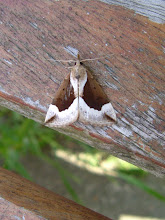
Orange Underwing,03 04 10
Friday, 2 April 2010
Thursday, 1 April 2010
April Tips on Sallow
If you have a garage or outside shed, etc, now is the time to start collecting Sallow catkins which have fallen on to the ground from the Sallow trees. Many of these fallen catkins will often contain various Tortricidae, Geometridae and Pug larvae. The way to check the catkins for larvae is very easy. Simply spread them out on white kitchen roll in some seed trays or similar, no need for any sort of lid at this stage. If you keep checking the catkins you will see signs of frass appearing on the white kitchen roll under the occupied catkins. Once you find these move them to a lidded container and keep an eye on the situation. The larvae may need fresh catkins adding and then as soon as the sallow leaves are out pop some leaves in the tub with the occupied catkins. Some catkins will have only one species and some will have more than one species on/in them. Most of these are fine kept together until they are large enough to ID. The only exception to this are Pug larvae which I find are mostly cannibalistic even when enough food is present, if you want more than one survivor its pays to house pug larvae in solitary confinement ! Its great fun with catkins at this time of the year as you never know what you might find and rear through.
We are now getting close to the one of the best times of the year to find moths on natural food sources. Any night now when its cloudy and reasonably mild its the time to go "Sallowing". This is one of the great classic tecniques used before the advent of MV lights to collect large numbers of moths in one place. Cromwell Bottom is an ideal place to try this out but any area with large numbers of Sallow in bloom is fine. You simply stick a few pots in your pocket, pack a decent torch and a butterfly net. In practice one simply walks around shining the torch on Sallow catkins until you pick out a moth feeding, they can usually be spotted by the light reflecting off their eyes. One a good night there can be hundreds of moths on each Sallow bush, but often around here one is lucky to get a few dozen per bush. If its moth sp you wish to confirm or look through a hand lens its usually dead easy to simply pop the net over them and tap them off the catkins. They are mainly Orthosia spp, but also Chestnut, Satellite, perhaps some Thorns and Pugs. The only other time of year when one can get the same effect with natural sources is in autumn when you search Ivy Blossom in the same manner.
This was originally posted by Paul Talbot in April 2008
We are now getting close to the one of the best times of the year to find moths on natural food sources. Any night now when its cloudy and reasonably mild its the time to go "Sallowing". This is one of the great classic tecniques used before the advent of MV lights to collect large numbers of moths in one place. Cromwell Bottom is an ideal place to try this out but any area with large numbers of Sallow in bloom is fine. You simply stick a few pots in your pocket, pack a decent torch and a butterfly net. In practice one simply walks around shining the torch on Sallow catkins until you pick out a moth feeding, they can usually be spotted by the light reflecting off their eyes. One a good night there can be hundreds of moths on each Sallow bush, but often around here one is lucky to get a few dozen per bush. If its moth sp you wish to confirm or look through a hand lens its usually dead easy to simply pop the net over them and tap them off the catkins. They are mainly Orthosia spp, but also Chestnut, Satellite, perhaps some Thorns and Pugs. The only other time of year when one can get the same effect with natural sources is in autumn when you search Ivy Blossom in the same manner.
This was originally posted by Paul Talbot in April 2008
Knott Wood Sunday night
We are having a session on sunday night if anyone fancies it,,if we meet at Saville Bowling Club at the small car park bout 1945 ish, its 10 min walk,although it will be muddy in parts.Oak Beauty is target.
Wednesday, 31 March 2010
A Nice way to round off March
sallowing
Sunday, 28 March 2010
Why did the caterpillar cross the road?
Knott Wood sat night

Mottled Grey

Red Chestnut

Engrailed
Met with Bri,Winston and Martyn at Knott wood last night, in Northowram the wind was cold and the skies clear whilst at Hebden it was pleasantly mild with light wind.A good catch followed for the time of year.One Orange underwing was seen whilst setting up ---
Common Quaker 40+
Chestnut 8
Satellite 3(white spots)
Twin Spotted quaker 6
Yellow Horned 10
Mottled Grey 6
Hebrew Character 2
Clouded drab 7
Engrailed 3
Red Chestnut 6
Diurnea fagella 3
Although most were attracted to light all species were also found by searching tree trunks with a torch.
Saturday, 27 March 2010
Friday Night in Hebden
2 x Common Quaker
2 x Satelite (One white spots, on orange)
2 x Chestnut
win :-)
2 x Satelite (One white spots, on orange)
2 x Chestnut
win :-)
Friday, 26 March 2010
Knott Wood sat 27 03 10
Thursday, 25 March 2010
Spring Flowers
Entomological Event at Frodsham
Hi all
Just a quick if somewhat belated plug for the Lancashire and Cheshire Annual Entomologcal meeting at Frodsham (around 45 mins up the M62). This is an annual event in which attracts decent (usually a couple of hundred) audiences and many exhibits with a couple of interesting talks given by experts in the afternoon session. Sue and I run a book stall, Ian Kimber usually runs a stall showing his UK Moths site and Rob Edmunds Leaf Mine site. Many moffers who attend such as Ben Smart, Ian Smith, Steve Hind will probably be know to you from various Moth E-forums. Entry is free and its held in a modern hall with decent heating, plenty of parking and you can buy food in ther hall or pubs and shops in the vicinity. Paul Hill of Bio-Equip will also be running a stall selling Moffing and other entomological equipment.
The meeting is open to the public from 11am until around 4/5 pm and opens this coming Saturday 27th March. Sue and I hope to see you there.
FRODSHAM COMMUNITY CENTRE Fluin Lane, Frodsham, Cheshire WA6
7QN
Phone 01928 732222,
GR...SJ521777
Multimap link
http://www.multimap.com/maps/?qs=WA6&countryCode=GB#map=53.29613,-2.71903|16|4&bd=useful_information&loc=GB:53.29612:-2.71904:16|WA6 7QN|WA6 7QN
Just a quick if somewhat belated plug for the Lancashire and Cheshire Annual Entomologcal meeting at Frodsham (around 45 mins up the M62). This is an annual event in which attracts decent (usually a couple of hundred) audiences and many exhibits with a couple of interesting talks given by experts in the afternoon session. Sue and I run a book stall, Ian Kimber usually runs a stall showing his UK Moths site and Rob Edmunds Leaf Mine site. Many moffers who attend such as Ben Smart, Ian Smith, Steve Hind will probably be know to you from various Moth E-forums. Entry is free and its held in a modern hall with decent heating, plenty of parking and you can buy food in ther hall or pubs and shops in the vicinity. Paul Hill of Bio-Equip will also be running a stall selling Moffing and other entomological equipment.
The meeting is open to the public from 11am until around 4/5 pm and opens this coming Saturday 27th March. Sue and I hope to see you there.
FRODSHAM COMMUNITY CENTRE Fluin Lane, Frodsham, Cheshire WA6
7QN
Phone 01928 732222,
GR...SJ521777
Multimap link
http://www.multimap.com/maps/?qs=WA6&countryCode=GB#map=53.29613,-2.71903|16|4&bd=useful_information&loc=GB:53.29612:-2.71904:16|WA6 7QN|WA6 7QN
Wednesday, 24 March 2010
Monday, 22 March 2010
Fame at last?
See article below from Birdguides, note the comments, we get a mention!
http://www.birdguides.com/webzine/article.asp?a=1996#comments
Sunday, 21 March 2010
Knott Wood Hebden Bridge,21 03 10


Spent most the day at Knottwood,7 Orange Underwings,had a go with mv,quite overwhelming,30 plus Yellow Horned,10 twinspot 40 common quakers,2engrailed,12 march moth,2 mottled grey,2 clouded drab,2 hebrew characters,5 chestnuts,2 diurnia fagella melanistic forms,2 pics of y horned,anntenae look more orangy to me !
Pixie Wood Sunday
Managed at least 9 Orange underwings today flying just above the canopy at Pixie wood some fantastic ariel displays going on in the sunshine.
Saturday, 20 March 2010
Keep the Faith


After the longest coldest winter in living memory at last we have had a couple of warm days.So far this week,
Oak Beauty x 1
Red Sword Grass x1
Pale Pinion x 2
Pale brindled Beauty x2
common Quaker x 5
hebrew Character x 3
March Moth x 3
Satellite x 2
Chestnut x 5
Went with Bri last night up Langfield looking for larvae and found 25 + Clouded Bordered Brindle ,1 lesser yellow underwing and 4 brown and 5 Green form of Anomalous larvae.
Friday, 19 March 2010
Knott Wood Hebden Bridge 19 03 10
Just had a couple of hours scanning the birches saw 2 Orange Underwings,well chuffed,thought it might have been to windy ! its great when you get your target species.regards Bri.
Thursday, 18 March 2010
Awakening
Hi everybody. I have been dormant for some time. Frozen in on the Rochdale canal! My 4th winter on the canal so far and it stands alone as completely different to all the previous ones. Anyway, really thawing this week. Put trap out for first time last night (17th March) and the following gathered...
Chestnut 5
March Moth 3
Yellow Horned 1
Common Quaker 3
Dotted Border 1
Total - 13
March Moth 3
Yellow Horned 1
Common Quaker 3
Dotted Border 1
Total - 13
Very pleased with the dotted border as this species has eluded the lens every year so for one reason or another.
Also went through the fallingroyd tunnel 2 days ago - 4 Heralds. probably more as I couldn't stop to look properly. Winston
Tuesday, 16 March 2010
Sunday, 14 March 2010
Heather larvae 2


Larvae swept from heather yesterday at Shibden ,I reckon its the same as the ones Charlie swept at Norland about 6mm and a micro larvae found on gorse?? .Collected E.Sangii from H.Beaumont at the YNU meeting last week,a first for calderdale taken at light at N.Carters house last year.The S,aurella mines are common on bramble throughout calderdale at the moment this is in my back garden.
Case for id,Langfield Edge,13 03 10

Hi all,found this case on cliff face at 6mm in length,made from bits of gritstone and debri,its empty unfortunately,so could prob be anything ?
Monday, 8 March 2010
Orange Underwing
Saturday, 6 March 2010
Knottwood Hebden Bridge,05 03 10


Found this amazing coleophora species yesterday while searching some heather,nearly discarded it ! but detected a slight movement ! its just over 2mm in lenght.searched for more but nowt,prob better beating than searching.looks like poss juncicolella ? size seems to fit as 4/5mm full size for that species is stated when full size is attained in late April ! see what others think.
Friday, 5 March 2010
GMS
Put the trap on tonight and found 688 Agonoptrix heracliana x2 and 1 Pale brindled beauty.
A good leaf mining tip from dereks blogg
http://wildyorkshire.blogspot.com/
And Bramham on Sunday meet Hx train station at 9.30.
Good to hear from winston this week his barge is now now free from ice and look forward to his posts soon.
A good leaf mining tip from dereks blogg
http://wildyorkshire.blogspot.com/
And Bramham on Sunday meet Hx train station at 9.30.
Good to hear from winston this week his barge is now now free from ice and look forward to his posts soon.
Monday, 1 March 2010
395 glyphipterix haworthana
Charlie,theres still plenty ,found 18 or so in a small area of Langfield Common,they are quite bedraggled,try and get the largest ones if you have a try.Paul,is Blackstone Edge in Calderdale or Greater Manchester ?
395 glyphipterix haworthana larval cases 28 02 10
Sunday, 28 February 2010
More Garden Moth Recorders in Yorkshire!
Only a week to go before the garden Moth scheme starts again for the Summer of 2010. If anyone would like to join please email me and i will forward your details to the Yorkshire recorder.All you have to do is record every common species on friday or sat in your garden trap.
Many thanks and here is to a bumper mothing year!
Jailhole 27th feb
Met with Bri last night and we headed for jailhole,last week it was below freezing and covered with snow ,so with great optimism we set off up the moor, there was still snow on the ground in places but the wind was light and a cloudy sky kept the temp above freezing.We scaled the quarry and found 21 Anomalous larvae 12 green form and 9 brown form,, size rang 1cm to aprox 13mm,also 2 large yellow underwing larva green form,and 2 prob Square Spot Rustic larva all feeding after dark on Wavy Hairgrass.
I was amazed to see so many larvae out in the open in late February(good old Tutt) it took only 90 mins to find all 25 larvae.A brilliant night and look forward to going back soon.Many thanks to Brian
Saturday, 27 February 2010
Whiteholme Drain,26 02 10
Hi all,on a walk along Whiteholme Drain,i counted over 100, 395 glyphipterix haworthana larval spinnings of cottongrass,mainly at northern end of drain and these were just the ones near the path ! must be excellent numbers in our area,wonder how many will survive after this Winter ! regards Bri.
Thursday, 25 February 2010
Jailhole,25 02 10
Sunday, 21 February 2010
Jailhole,Langfield Edge,20 02 10
Andy and me checked for Anomalous larva after dark,quite deep snow on hillside and rockfaces,and even though there were snow free patches of the foodplant Wavy Hairgrass, and it felt quite mild under the rockfaces,it was still below freezing and we never found any.i have found them in the past when icy, feeding,maybe it needs to be just above freezing before they start to feed,and who could blame em ! Found 2 green form on 14 12 09 when it was quite mild at aprox 12mm in size,incidently a green form larva that was kept a couple of seasons ago a male emerged ! do you sometimes wonder what you have got into !!
Thursday, 18 February 2010
News from Todmorden,18 02 10
Hi all,found my 1st diurnea fagella of the year today melanic male on a fence post.regards Bri.
Of interest?
Steve Whitehouse' account of some rare moths in 2009
http://www.birdguides.com/webzine/article.asp?a=1951
Sunday, 14 February 2010
Puss Moth and sallow Kitten Pupa
Saturday, 13 February 2010
First moth of the year!
I also tried the actinic last night and was rewarded with one Small Quaker, a nice rustic one at that! Not a bad start after a long cold winter.
Friday, 12 February 2010
Knott Wood 12 02 10
Tuesday, 9 February 2010
Clouded Bordered Brindle Larva
Sunday, 7 February 2010
2010 Mothing so far.
Hi all,had a try with mv 05 02 10 at meadows edge garden dusk till dawn and no moths,although quite mild,a cold mist soon descended.Had a go at Knott Wood tonight with Actinic but the tube just died after about 1/2 hour,frustrating ! but i did find 2 Chestnut ads on vegetation after dark,also 7 Clouded Bordered Brindle and 1 Large Yellow Underwing Larva feeding on Wavy Hairgrass after dark.all the best Bri.
Monday, 1 February 2010
Bramham YNU meeting 7th March 2010
Hi all ,I am going to try and make the YNU meeting at Bramham this year its on Sunday 7th March.,If anyone else fancies it, we could try and get a car load together.??
Tuesday, 26 January 2010
New Blogg
Sunday, 24 January 2010
Search those tunnels near You,!!!!!
This eaxtract is taken off the Yorkshire Moth yahoo group and should be interesting to all who read this Blogg...many thanks to Yorkshire Yahoo and C.Fletcher for this post......
I've never thought of looking in the Serpentine Tunnel
before but now you mention it, it's an obvious site for Heralds.
It's a great time of year for looking
in caves, tunnels etc with a good torch to see what is about. One particular
cave in the Dales has over 200 Tissues hibernating at the moment, and this
species may well occur in other parts of the county - don't think it just occurs
near buckthorn. The books are likely to be wrong and it uses other foodplants.
Heralds turn up in all sorts of places such as garden sheds and outhouses so you
might find them at home.
Red-green Carpet is interesting. Out of 1500+ records on the database the only
one I can find of hibernation is one inside a bird hide in February a few years
ago, so we know very little about where most of them hibernate. The only other
hibernating species on the database is Tawny Pinion (two records) so where do
all these over-wintering moths shelter from the frosty weather?
So if anyone is at a loose end, do take a torch and explore some local nooks and
crannies!
I've never thought of looking in the Serpentine Tunnel
before but now you mention it, it's an obvious site for Heralds.
It's a great time of year for looking
in caves, tunnels etc with a good torch to see what is about. One particular
cave in the Dales has over 200 Tissues hibernating at the moment, and this
species may well occur in other parts of the county - don't think it just occurs
near buckthorn. The books are likely to be wrong and it uses other foodplants.
Heralds turn up in all sorts of places such as garden sheds and outhouses so you
might find them at home.
Red-green Carpet is interesting. Out of 1500+ records on the database the only
one I can find of hibernation is one inside a bird hide in February a few years
ago, so we know very little about where most of them hibernate. The only other
hibernating species on the database is Tawny Pinion (two records) so where do
all these over-wintering moths shelter from the frosty weather?
So if anyone is at a loose end, do take a torch and explore some local nooks and
crannies!
Thursday, 21 January 2010
Friday, 15 January 2010
Wednesday, 13 January 2010
Butterfly migration mystery solved
Scientists with the charity Butterfly Conservation believe they have solved one of nature’s long-standing mysteries – thanks to the help of the public.
Every year Painted Lady butterflies arrive in the UK from North Africa and the Mediterranean. It has long been known that they breed here during the summer and also that they cannot normally survive our winters. What happens to these Painted Ladies as winter approaches was unknown until now.
Scientists had been baffled as to whether Painted Ladies attempted to “tough it out” and died trying during our winters. Or was there a return southward migration to warmer climes, as is the case with Swallows, Cuckoos and Red Admiral butterflies? Part of the problem has been that, unlike these other well-known migrants, there was very little evidence of Painted Ladies flying south in the autumn.
This summer was a bumper migration year with, at the peak, up to a billion Painted Ladies in Britain.
Butterfly Conservation has been monitoring Painted Lady movements since the start of northward migration at the beginning of the year, with members of the public being able to report sightings online at www.butterfly-conservation.org. There has been a huge response, not only from the UK but from across Europe. An amazing 12,000 sightings have been submitted so far, with reports still coming in.
Last month brought some particularly exciting reports. From the Channel coasts of Cornwall, Devon, Sussex and Kent sightings were reported of Painted Ladies heading straight out to sea towards continental Europe.
Now reports have been received of butterflies arriving back in the Mediterranean and North Africa.
Richard Fox, Butterfly Conservation’s surveys manager, said: “Several of these lucky observers saw more than one butterfly head out on its perilous voyage. This is exactly the evidence needed to lay this enduring mystery to rest. Painted Ladies do return southwards from Britain in the autumn enabling the species to continue its breeding cycle during the winter months”.
Thanks to Yorkshire Butterflies for this info.
Every year Painted Lady butterflies arrive in the UK from North Africa and the Mediterranean. It has long been known that they breed here during the summer and also that they cannot normally survive our winters. What happens to these Painted Ladies as winter approaches was unknown until now.
Scientists had been baffled as to whether Painted Ladies attempted to “tough it out” and died trying during our winters. Or was there a return southward migration to warmer climes, as is the case with Swallows, Cuckoos and Red Admiral butterflies? Part of the problem has been that, unlike these other well-known migrants, there was very little evidence of Painted Ladies flying south in the autumn.
This summer was a bumper migration year with, at the peak, up to a billion Painted Ladies in Britain.
Butterfly Conservation has been monitoring Painted Lady movements since the start of northward migration at the beginning of the year, with members of the public being able to report sightings online at www.butterfly-conservation.org. There has been a huge response, not only from the UK but from across Europe. An amazing 12,000 sightings have been submitted so far, with reports still coming in.
Last month brought some particularly exciting reports. From the Channel coasts of Cornwall, Devon, Sussex and Kent sightings were reported of Painted Ladies heading straight out to sea towards continental Europe.
Now reports have been received of butterflies arriving back in the Mediterranean and North Africa.
Richard Fox, Butterfly Conservation’s surveys manager, said: “Several of these lucky observers saw more than one butterfly head out on its perilous voyage. This is exactly the evidence needed to lay this enduring mystery to rest. Painted Ladies do return southwards from Britain in the autumn enabling the species to continue its breeding cycle during the winter months”.
Thanks to Yorkshire Butterflies for this info.
ON line Recording.
If you click on the link you can now add your records on line ,please have a go and see if it works.Thanks to Nigel Kerwin for the knowledge
Tuesday, 12 January 2010
Bramham YNU Lepidoptera Group meeting
Hi all ,I am going to try and make the YNU meeting at Bramham this year I think its in March usually,If anyone else fancies it, we could try and get a car load together.??
National Moth Night 2010 + gen det
National Moth Night is on Sat 15th May at Shibden/Cunnery Wood. We will have a couple of moth traps going(hopefully more) + a bat walk. All welcome to this event.Lets hope its not snowing.?
Had a go at a bit of gen det today and id a male Grey Pug caught at light at Cunnery Wood on the 6th May 2009.And 1 Copper Underwing caught at light Northowram in September.The 5 female type pugs I could not id.
Early Moth...??????
1960 Early Moth Theria primaria (Haworth)
There are 4 old records the last in 1963 and recent records from Park road elland between mid january and mid march.The flight time for this species is January and February when few light traps are run.The foodplant is hawthorn and a careful search may reveal this species to be present.They can be seen at dusk at rest on bare open twigs of foodplant.The female is flightless
Friday, 1 January 2010
Wednesday, 16 December 2009
Many Thanks and merry X-mas
Many thanks to everyone who has conributed to this site over the last year,some excellent records have been gathered and a steady picture is arising of the wealth of calderdales moths and butterfly species.White Letter hairstreaks ,Leopard moths,Broad Barred White, Blacknecks,Double Dart,Puss Moths,Scarce silver Y's,Muslin footman200 Psychoides filicivora(a first for Yorkshire well done CS)Eriocrai sangii and many many more.Look forward to meeting up with you all next year on a field trip near you,all the best for X-mas and the new year.I hope this blogg has help you enjoy this fasinating subject. Andy
Monday, 14 December 2009
Work in progress 2.
I have added a link to a list of moths recorded in Calderdale.It still need a lot of work but you will get the idea.
Wednesday, 9 December 2009
Last Night in Hebden Bridge
Big fat zero I'm afraid. Seemed like a decent night and hope for something but alas no. Winston
Saturday, 5 December 2009
National Moth Night 2010
National Moth Night 2010 will take place on Saturday 15 May 2010 and the theme will be Moths
and Bats. This will enable us to stress the importance of moths and highlight the links between
these two groups of much maligned creatures, both of which are in decline. Joint moth and bat
events would also be highly appropriate. As usual it will be jointly organised by Atropos and
Butterfly Conservation (through the Moths Count team), but we will also be joined for NMN2010
by the Bat Conservation Trust. You can record moths as usual for NMN, but if you are
organising an event for family, friends or the public, you could incorporate bat recording as an
added feature. You can make contact with local bat groups via www.bats.org.uk/bat_group.php.
and Bats. This will enable us to stress the importance of moths and highlight the links between
these two groups of much maligned creatures, both of which are in decline. Joint moth and bat
events would also be highly appropriate. As usual it will be jointly organised by Atropos and
Butterfly Conservation (through the Moths Count team), but we will also be joined for NMN2010
by the Bat Conservation Trust. You can record moths as usual for NMN, but if you are
organising an event for family, friends or the public, you could incorporate bat recording as an
added feature. You can make contact with local bat groups via www.bats.org.uk/bat_group.php.
Thursday, 3 December 2009
News from Todmorden 3 12 09
Is this the final find of 2009
Sunday, 22 November 2009
Not much of a result!
Friday, 20 November 2009
Traps out?
Sandra reports three flying moths seen whilst she was cycling home this evening, our trap is out!
Wednesday, 18 November 2009
Last call for records
Hi all,been a busy with work of late and little to reportbut I have been collecting records and have amassed 4,000 for this year so far(many thanks to everyone who has forwarded records).If any body has any records please e-mail me ,,,I can then forward them to the Yorkshire recorder.Cheers
Saturday, 14 November 2009
News from Todmorden 12 11 09
Another Red Admiral seen today 12 11 09, by Ros Berrington,also 4 Plume moth adult, species disturbed from leylandii hedge ?
Thursday, 12 November 2009
Wednesday, 11 November 2009
Project Tityrella
Hi All
Found another of these leaf mines today... Had even more od a 'Green Island' effect than Charlie's. It seems that the way the larvae mine the leaf, their food supply is prolonged? Cleaver. I am assuming the larvae fall to earth to pupate or simple crawl out of their leaf once it has fallen?
Win
Found another of these leaf mines today... Had even more od a 'Green Island' effect than Charlie's. It seems that the way the larvae mine the leaf, their food supply is prolonged? Cleaver. I am assuming the larvae fall to earth to pupate or simple crawl out of their leaf once it has fallen?
Win
Tuesday, 10 November 2009
Dry Night Tonight?
Looks like a dry night is forecast. Only light winds and about 3 deg. Not great but the best forecast for a while overnight. Might be worth putting the traps on and see ifanyone can actually post a trapped moth on the blog! Lets see.
Win
Win
Monday, 2 November 2009
Subscribe to:
Posts (Atom)